Question
Write and explain principle of superposition for stationary electric forces.

Answer

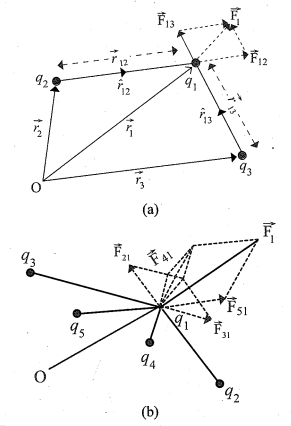
Image
►The mutual electric force between two charges is given by Coulomb's law.
►But if more than two charges are present Super position principle is needed in addition to the Coulomb's law, to find the force exerted on one of the charges by the remaining charges.
►To better understand the concept, consider a system of three charges $q_1, q_2$ and $q_3$, as shown in Fig. (a). The force on one charge, say $q_1$, due to two
►other charges $q _2, q _3$ can therefore be obtained by performing a vector addition of the forces due to each one of these charges. Thus, if the force on $q _1$ due to $q _2$ is denoted by $F _{12}$.
Thus, $\overrightarrow{ F }_{12}=\frac{1}{4 \pi \varepsilon_0} \frac{q_1 q_2}{r_{12}^2} \hat{r}_{12}$
►In the same way, the force on $q_1$ due to $q_3$, denoted by $\vec{F}_{13}$, is given by
$\overrightarrow{ F }_{13}=\frac{1}{4 \pi \varepsilon_0} \frac{q_1 q_3}{r_{13}^2} \hat{r}_{13}$

►which again is the Coulomb force on $q_1$ due to $q_3$, even though other charge $q_2$ is present.
►Thus the total force $\vec{F}_1$ on $q_1$ due to the two charges $q_2$ and $q_3$ is given as :
$\begin{aligned}
\overrightarrow{ F }_1 & =\overrightarrow{ F }_{12}+\overrightarrow{ F }_{13} \\
& =\frac{1}{4 \pi \varepsilon_0}\left(\frac{q_1 q_2}{r_{12}^2} \hat{r}_{12}+\frac{q_1 q_3}{r_{13}^2} \hat{r}_{13}\right)
\end{aligned}$

►The principle of superposition says that in a system of charges $q_1, q_2, \ldots q_n$, the force on $q_1$ due to $q_2$ is the same as given by Coulomb's law, i.e., it is unaffected by the presence of the other charges $q_3, q_4, \ldots, q_n$

►The total force $\overrightarrow{ F }_1$ on the charge $q_1$, due to all other charges, is then given by the vector sum of the forces $\overrightarrow{ F }_{12}, \overrightarrow{ F }_{13}, \ldots, \overrightarrow{ F }_{1 n}$. i.e.,
$\begin{aligned}
\overrightarrow{ F }_1 & =\overrightarrow{ F }_{12}+\overrightarrow{ F }_{13}+\ldots \ldots \ldots \ldots . .+\overrightarrow{ F }_{1 n} \\
& =\frac{1}{4 \pi \varepsilon_0}\left[\frac{q_1 q_2}{r_{12}^2} \hat{r}_{12}+\frac{q_1 q_3}{r_{13}^2} \hat{r}_{13}+\ldots \ldots+\frac{q_1 q_n}{r_{1 n}^2} \hat{r}_{1 n}\right] \\
& =\frac{q_1}{4 \pi \varepsilon_0} \sum_{i=2}^n \frac{q_i}{r_{1 i}^2} \hat{r}_{1 i}
\end{aligned}$

Need a full question paper?

Generate a complete, print-ready paper with questions like this in minutes — across 16+ boards, with answer keys.
Start Generating Free

Similar questions

A circular coil of 16 turns and radius 10 cm carrying a current of 0.75 A rests with its plane normal to an external field of magnitude $5.0 \times 10^{–2} T$. The coil is free to turn about an axis in its plane perpendicular to the field direction. When the coil is turned slightly and released, it oscillates about its stable equilibrium with a frequency of $2.0\ s^{–1}$. What is the moment of inertia of the coil about its axis of rotation?
  1. Define torque acting on a dipole of dipole moment $\overrightarrow{p}$ placed in a uniform electric field $\overrightarrow{\text{E}}$. Express it in the vector form and point out the direction along which it acts
  2. What happens if the field is non-uniform?
  3. What would happen if the external field $\overrightarrow{\text{E}}$ is increasing (i) parallel to $\overrightarrow{p}$ and (ii) anti-parallel to $\overrightarrow{p}$?
How are electromagnetic waves produced? What is the source of energy of these waves? Draw a schematic sketch of the electromagnetic waves propagating along the + x-axis. Indicate the directions of the electric and magnetic fields. Write the relation between the velocity of propagation and the magnitudes of electric and magnetic fields.
A swimmer wishes to cross a 500m wide river flowing at 5km/h. His speed with respect to water is 3km/h.
  1. If he heads in a direction making an angle 0 with the flow, find the time he takes to cross the river.
  2. Find the shortest possible time to cross the river.
A thin prism of crown glass $(\mu_\text{r}=1.515,\mu_\text{v}=1.525)$ and a thin prism of flint glass $(\mu_\text{r}=1.612,\mu_\text{v}=1.632)$ are placed in contact with each other. Their refracting angles are 5.0° each and are similarly directed. Calculate the angular dispersion produced by the combination.
$a.$ Differentiate between nuclear fission and nuclear fusion.
$b.$ Deuterium undergoes fusion as per the reaction:
${ }_1^2 H +{ }_1^2 H \longrightarrow{ }_2^3 He +{ }_0^1 n +3.27 MeV$
Find the duration for which an electric bulb of $500 W$ can be kept glowing by the fusion of $100 g$ of deuterium.
A metal sphere of radius R is charged to a potential V:
  1. Find the electrostatic energy stored in the electric field within a concentric sphere of radius 2R.
  2. Show that the electrostatic field energy stored outside the sphere of radius 2R equals that stored within it.
What is electric flux? Write its S.I. units.Using Gauss’s theorem, deduce an expression for the electric field at a point due to a uniformly charged infinite plane sheet.
Two particles A and B having charges of $+2.00 \times 10^{-6}C$ and of $-4.00 \times 10^{-6}C$ respectively are held fixed at a separation of 20.0cm. Locate the point(s) on the line AB where
  1. The electric field is zero.
  2. The electric potential is zero.
The electric current in an X-ray tube (from the target to the filament) operating at 40kV is 10mA. Assume that on an average, 1% of the total kinetic energy of the electron hitting hte target are converted into X-rays.
  1. What is the total power emitted as X-rays
  2. How much heat is produced in the target every second?