Question
Write any four economic importance of Pteridophyta.

Answer

Economic Importance of Pteridophyta: 
1. Ornamental Value:
Many ferns are grown in gardens because they look large and beautiful. Example: Species of Lycopodium, Selaginella, Lygodium, Cyathea etc.
2. Food: Sporocarp of Marsilea has high amount of starch. These are used as nutritious food by the tribals.
3. Soil Conservation: Selaginella is useful in soil conservation.
4. Medicines: Anthelmintic drug is obtained from rhizomes and petioles of Dryopteris fern. Lycopodium clovetum is used in skin diseases. Equisetum arvense has diuretic properties.

Need a full question paper?

Generate a complete, print-ready paper with questions like this in minutes — across 16+ boards, with answer keys.

Start Generating Free

Similar questions

Write any two functions of leaves found in fern. Write any four differences between green algae and red algae.
Briefly describe the structure of the Brain.
Define the following :
(i) Vasa Recta (ii) Homeostasis (iii) Podocytes (iv) Juxtamedullary Nephron.
Describe briefly the four major groups of Protozoa.
Describe the evolutionary change in the pattern of heart among the vertebrates.
In addition to proteins, viruses also contain genetic material, that could be either RNA or DNA. No virus contains both RNA and DNA. A virus is a nucleoprotein and the genetic material is infectious. In general, viruses that infect plants have single stranded RNA and viruses that infect animals have either single or double stranded RNA or double stranded DNA. Bacterial viruses or bacteriophages (viruses that infect the bacteria) are usually double stranded DNA viruses. The protein coat called capsid made of small subunits called capsomeres, protects the nucleic acid. These capsomeres are arranged in helical or polyhedral geometric forms. Viruses cause diseases like mumps, small pox, herpes and influenza. AIDS in humans is also caused by a virus. In plants, the symptoms can be mosaic formation, leaf rolling and curling, yellowing and vein clearing, dwarfing and stunted growth.

(1) Viruses are made up of:
(a) Proteins & DNA
(b) Proteins only
(c) Proteins & RNA
(d) Proteins & DNA / RNA

(2) Bacteriophages are usually :
(a) Single stranded DNA viruses
(b) Double stranded RNA viruses
(c) Double stranded DNA viruses
(d) Single stranded RNA viruses

(3) Which is not a viral disease of humans:
(a) Pneumonia (b) Herpes (c) Mumps (d) Smallpox

(4) Select the incorrect statement regarding Capsomeres:
(a) Capsomeres are sub-units of Capsid
(b) Capsomeres are made of peptidoglycans
(c) Capsomeres may be arranged in helix or polyhedron
(d) Capsomeres are made of proteins

(5) Which of these is not a symptom of viral infection in crops:
(a) Leaf rolling (b) Curling of leaf (c) Decay of roots (d) Vein clearing
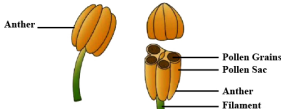
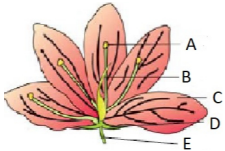
The androecium is composed of stamens. Each stamen that represents the male reproductive organ consists of a stalk or a filament and an anther. Each anther is usually bilobed and each lobe has two chambers, the pollen-sacs. Stamens of flowers may be united with other members such as petals or among themselves. The stamens may be epipetalous or epiphyllous. A flower is a modified shoot wherein the shoot apical meristem changes to floral meristem. Internodes do not elongate and the axis gets condensed. The apex produces different kinds of floral appendages laterally at successive nodes instead of leaves. The arrangement of flowers on the floral axis is termed an inflorescence.
Image

i. Observe the figure and mention what is androecium composed of. (1)
ii. The pollen grains are produced in pollen-sacs. What is a sterile stamen is called? (1)
iii. Is salvia and mustard show variation in the length of filaments within a flower? (2)

OR

Mention statement justifies that the given figure is racemose inflorescence. (2)
Image
Mention the ploidy of the following: protonemal cell of a moss; primary endosperm nucleus in dicot, leaf cell of a moss; prothallus cell of a ferm; gemma cell in Marchantia; meristem cell of monocot, ovum of a liverwort, and zygote of a fern.