Question
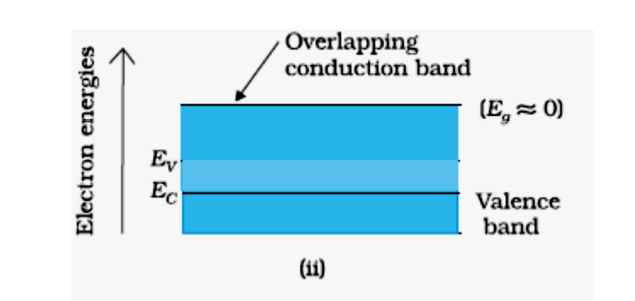
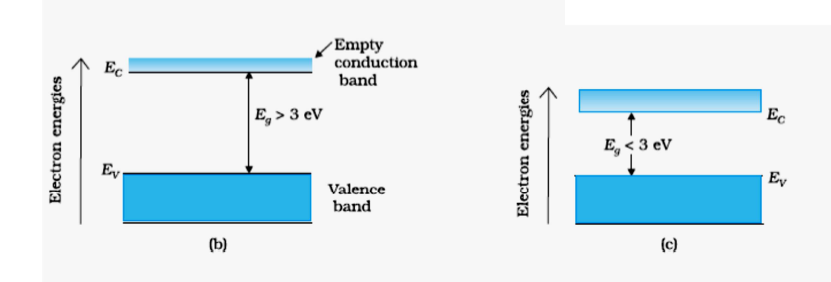
Write any two distinguishing features between conductors, semiconductors and insulators on the basis of energy band diagrams.

Answer


Two distinguishing features:
  1. In conductors, the valency band and conduction band tend to overlap (or nearly overlap) while in insulators they are seperated by a large energy gap and in semiconductors are separated by a small energy gap.
  2. The conduction band, of a conductor, has a large number of electrons available for electrical conduction. However the conduction band of insulators is almost empty while that of the semi- conductor has only a (very) small number of such electrons available lectrical conduction.

Need a full question paper?

Generate a complete, print-ready paper with questions like this in minutes — across 16+ boards, with answer keys.
Start Generating Free

Similar questions

Calculate the energy released by 1g of natural uranium assuming 200MeV is released in each fission event and that the fissionable isotope 235U has an abundance of 0.7% by weight in natural uranium.
Average lifetime of a hydrogen atom excited to n = 2 state is 10-8s. Find the number of revolutions made by the electron on the average before it jumps to the ground state.
Show that the radiation pressure exerted by an EM wave of intensity I on a surface kept in vacuum is I/c.
A circular loop of radius R carries a current I. Another circular loop of radius r ( << R) carries a current i and is placed at the centre of the larger loop. The planes of the two circles are at right angle to each other. Find the torque acting on the smaller loop.
Obtain the answers (a) to (b) in Exercise 7.13 if the circuit is connected to a high frequency supply (240V, 10kHz). Hence, explain the statement that at very high frequency, an inductor in a circuit nearly amounts to an open circuit. How does an inductor behave in a dc circuit after the steady state?
A circular hole of diameter 2.00cm is made in an aluminium plate at 0°C. What will be the diameter at 100°C? $\alpha$ for aluminium= 2.3 × 10⁻⁵ °C-1.
(a) Explain the meaning of the statement "electric charge of a body is quantised". (b) Why can one ignore quantisation of electric charge when dealing with macroscopic i.e., large scale charges?
Potential at an instant $t$ in an ac circuit is $E=200 \sin 157 t . \cos 157 t$ volts and current is $I=\sin \left(314 t+\frac{\pi}{3}\right) \quad$ Amperes. In this condition calculate :
(a) frequency
(b) root mean square value of voltage
(c) impedance of the circuit
(d) power factor.
In Young’s double slit experiment, the two slits 0.15 mm apart are illuminated by monochromatic light of wavelength 450 nm. The screen is 1.0 m away from the slits.
  1. Find the distance of the second (i) bright fringe, (ii) dark fringe from the central maximum.
  2. How will the fringe pattern change if the screen is moved away from the slits?
  1. Explain with the help of a diagram formation of depletion region and barrier potential in a pn junction.
  2. Draw the circuit diagram of a half wave rectifier and explain its working.