Question
Write brief note on the following: Synaptonemal complex.

Answer

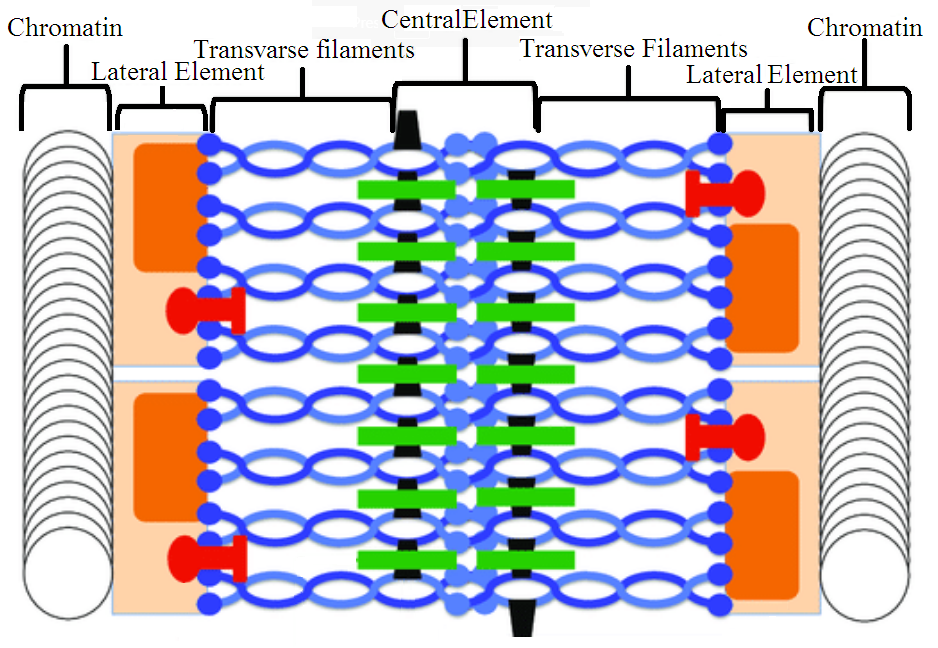
The synaptonemal complex is a tripartite, ribbon-like structure, and is sihiated between pairing homologous chromosomes. It consists of a dense central element, with a dense lateral element on either side. Each lateral element is attached on the inner side of a homologous chromosome. The space between the central and lateral elements is traversed by a series of transverse units of LC fibres (L for lateral and C for central), which connects the two. The synaptonemal complex is attached at both ends through its lateral elements to the inner surface of the nuclear membrane. The central element is not attached directly. Also arising from the lateral elements is another series of smaller loops. These loops fuse in the middle line to make up the central element. The transverse parts of the loops form the transverse units or LC fibres. The central element is simple in some organisms (e.g., frogs and mice) and tripartite in other (e.g., insects). Each lateral element consists of two protein filaments, one for each sister chromatid. Synaptonemal complex first appears during zygotene.

Need a full question paper?

Generate a complete, print-ready paper with questions like this in minutes — across 16+ boards, with answer keys.
Start Generating Free

Similar questions

Answer the following: How many types of nephridia are found in earthworm based on their location?
Name the hormones, their source glands and their mode of functioning to achieve calcium hormeostasis in the human body.
What name is given to the common axis, where a number of leaflets are arranged? What does it represent morphologically? Give one difference between leaf and leaflet.
The Rhizobium lives in a symbiotic association with leguminous plants. This kind of relationship teaches us which of the following lessons? What are the benefits of cooperation for humans?
  1. We should learn to take benefit from others.
  2. Cooperation is always good for mutual benefit.
  3. We should always maintain friendly relations with our neighbours.
Explain the pelvic girdle of human skeleton.
Distinguish between blind spot and yellow spot.
During a visit to a botanical garden, the teacher showed students an old tree which was on the verge of extinction. As soon as the teacher left, some notorious students climbed up the tree and started cutting the branches, collecting its leaves as previous collection. Saumya instead took photographs from various angles. The boys mocked at Saumya, while the teacher appreciated her.
  1. Why should we conserve biodiversity?
  2. What role is played by botanical garden in the conservation of biodiversity?
  3. Who besides botanists look after plants in botanical gardens?
  4. What values did Saumya possess?
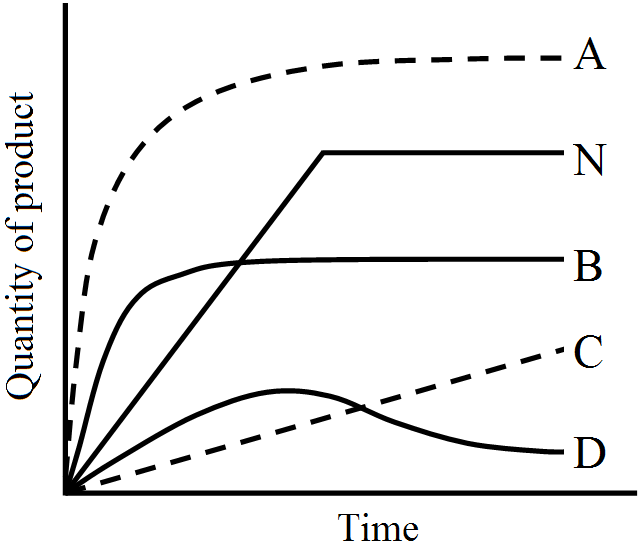
The lines A to D below show how change in temperature can affect the rate of enzyme reaction. Line N shows the rate of reaction under optimum temperature. Which line A, B, C or D shows the rate of enzyme reaction at 60°C?
Explain the working mechanism of hormones that control the dilution and concentration of urine.
Distinguish between the following: Glycolysis and Citric acid cycle