Question
  1. Write chemical equations when:
  1. Borax is heated strongly.
  2. Aluminium is treated with dilute NaOH.
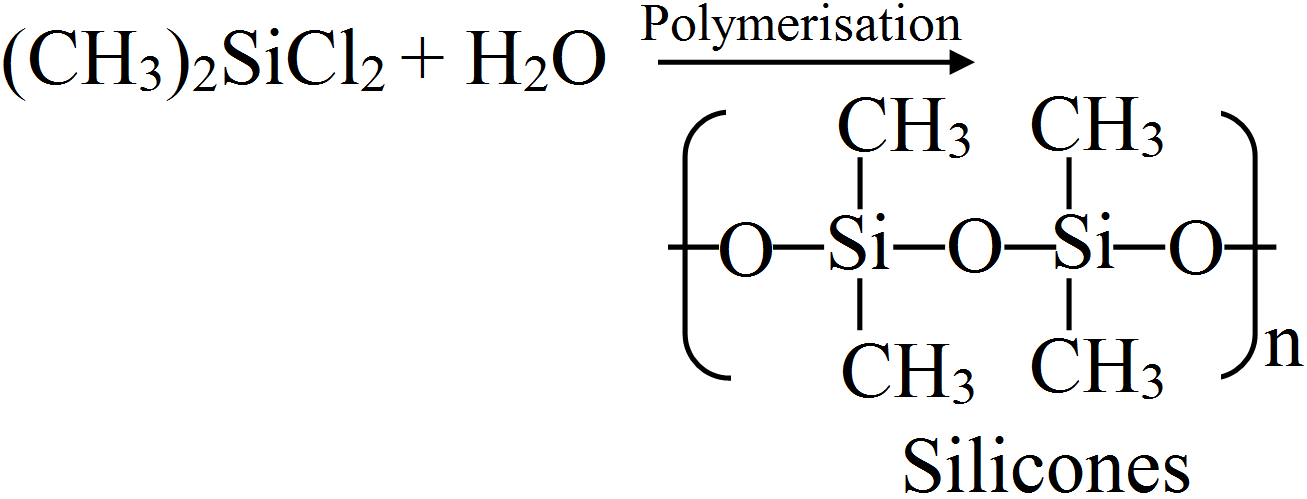
  3. Dimethyldichlorosilane is hydrolysed followed by condensation polymeri-sation.
  1.  
  1. Explain that $CO_2$ is a gas while $SiO_2$ is solid at room temperature.
  2. $SnCl_2$​​​​​​​ acts as reducing agent. Explain.

Answer

  1.  
  1. $\text{Na}_2\text{B}_4\text{O}_7.10\text{H}_2\text{O}\xrightarrow{\ \ \ \text{heat}\ \ \ }\text{Na}_2\text{B}_4\text{O}_7\\ \ \ \ \ \ \ \ ^\text{Borax}\\ \xrightarrow{\ \ \text{heat}\ \ }2\text{NaBO}_2+\text{B}_2\text{O}_3\\ \ \ \ \ \ \ \ \ \ \ \ \ \ \ ^\text{Sodium}\ \ \ \ \ \ \ \ ^\text{Boric}\\ \ \ \ \ \ \ \ \ \ \ \ \ ^\text{metaborate}\ \ \ ^\text{anhydride}$
  2. $2\text{Al}+2\text{NaOH}+2\text{H}_2\text{O}\xrightarrow{\ \ \ \ }2\text{NaAlO}_2+3\text{H}_2\\ \ \ \ \ \ \ \ \ \ \ \ \ \ \ \ \ \ \ \ \ \ \ \ \ \ \ \ \ \ \ \ \ \ \ \ \ \ \ \ \ \ \ \ \ \ \ \ \ ^\text{Sodium}\\ \ \ \ \ \ \ \ \ \ \ \ \ \ \ \ \ \ \ \ \ \ \ \ \ \ \ \ \ \ \ \ \ \ \ \ \ \ \ \ \ \ \ \ ^\text{metaaluminate}$
  3.  
  1.  
  1. $CO_2$ exists as descrete molecules whereas $SiO_2$ is three dimensional covalent solid.
  2. $Sn^{4+}$ is more stable than $Sn^{2+}$, therefore $SnCl_2$ is good reducing agent.

Need a full question paper?

Generate a complete, print-ready paper with questions like this in minutes — across 16+ boards, with answer keys.

Start Generating Free

Similar questions

Which method can be used to find out strength of reductant/oxidant in a solution? Explain with an example.
Match the following prefixes with their multiples:
 
Prefix
Multiples
(i)
micro
$10^6$
(ii)
deca
$10^9$
(iii)
mega
$10^{-6}$
(iv)
giga
$10^{-15}$
(v)
femto
$10$
Write short note on carcinogenic and toxicity of aromatic hydrocarbons.
On the basis of VSEPR theory, compare the geometries of molecules of types $AB _2 E , AB _3 E$, $AB _2 E _2, AB _4 E , AB _3 E _2, AB _5 E$ and $AB _4 E _2$ with various examples. (Here $E =$ lone electron pair)
Some time ago formation of polar stratospheric clouds was reported over Antarctica. Why were these formed? What happens when such clouds break up by warmth of sunlight?
Explain the following:
(a) Aufbau's principle
(b) Hund's law of maximum multiplicity
(c) Stability of half filled and full orbitals.
At $450K, K_p= 2.0 \times 10^{10}/bar$ for the given reaction at equilibrium.
$2\text{SO}_2\text{(g) + O}_2\text{(g)}\rightleftharpoons\text{2SO}_3\text{(g)}$
What is $K_c$ at this temperature?
Explain briefly about the electrochemical series and give its main uses.
The first ionization enthalpy values (in $\mathrm{kJ} \mathrm{~mol}^{-1}$ ) of group 13 elements are:
B Al Ga In Tl
801 577 579 558 589
How would you explain this deviation from the general trend?
a. Name two group 2 elements which do not impart colour to the flame and why?
b. Arrange $\mathrm{K}_2 \mathrm{CO}_3, \mathrm{MgCO}_3, \mathrm{CaCO}_3, \mathrm{BeCO}_3$, in increasing order of thermal stability and why?
c. Which metal hydroxide is most soluble in water in group 2 and why?
d. What is Epsom salt?
e. Why is $\mathrm{Na}_2 \mathrm{O}_2$ diamagnetic?