Question
Write chemical reactions to convert phenol into salicyaldehyde. Write the name of the reaction. What happens when if $CCl_4$ is used instead of $CHCl_3​​​​​​​$​​​​​​​ in the above reaction.

Answer

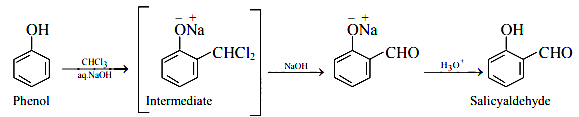
  1. Phenol to salicyaldehyde: When phenol is treated with chloroform in an aqueous sodium hydroxide solution followed by hydrolysis with acid, salicylaldehyde is formed.
  2. This reaction is known as the Reimer-Tiemann reaction.
  3. If the solvent chloroform $(CHCl_3)$ is replaced by carbon tetrachloride $(CCl_4)$, salicylic acid is formed.

Need a full question paper?

Generate a complete, print-ready paper with questions like this in minutes — across 16+ boards, with answer keys.

Start Generating Free

Similar questions

Write the chemical reaction for the preparation of the following polymer.
polyisoprene
Graphite is a covalent solid yet soft and good conductor of electricity.
Calculate enthalpy of formation of propane from the following data : Heat of sublimation of graphite is $716 kJ mo ^{-1}$.
Bond enthalpies$H - H$$C - H$$C - C$
$\Delta H ^0 kJ mol ^{-1}$$436.4$414350
 
Explain the structure of sucrose.
Explain with vapour pressure-temperature curves that the freezing point of a solvent is lowered by dissolving a nonvolatile solute into it. Give reason for such lowering of freezing of solvent.
Deduce the mathematical expression of first law of thermodynamics for the following processes :
$(1)$ Isothermal process
$(2)$ Isobaric process
$(3)$ Isochoric process
$(4)$ Adiabatic process.
What happens when chlorine reacts with? $S_8$
An aqueous solution of a certain organic compound has a density of 1.063 gmL-1, an osmotic pressure of 12.16 atm at 25°C and a freezing point of -1.03°C. What is the molar mass of the compound? (334 g/mol)
An element has a bcc structure with unit cell edge length of $288\ pm.$ How many unit cells and number of atoms are present in $200\ g$ of the element?
$(1.16 \times 10^{24}, 2.32 \times 10^{24})$
$QU : (1)$ Alkyl halides though polar are immiscible with water.
$QU : (2) \ C-F$ bond in $CH_3F$ is the strongest bond and $C-I$ bond in $CH_3I$ is the weakest bond. Explain.
$QU : (3)$ The boiling point of alkyl iodide is higher than that of alkyl fluoride.
$QU : (4)$ The boiling point of isopropyl bromide is lower than that of it$-$propyl bromide.
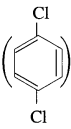
$QU : (5) \ p-$Dichlorobenzene Image has mp. higher than those of $o-$ and $rn-$ isomers.