Question
Write Clemmenson:

Answer

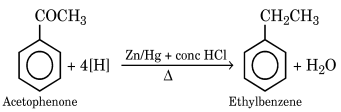
Clemmenson Reduction : This reduction of aldehydes and ketones to the corresponding hydrocarbons with $Zn / Hg$ and concentrated HCl is called Clemmenson reduction. For example,
$CH _3 COCH _3+4[ H ] \frac{ Zn / Hg +\text { conc. } HCl }{\Delta} \rightarrow CH _3 CH _2 CH _3+ H _2 O$
Image

Need a full question paper?

Generate a complete, print-ready paper with questions like this in minutes — across 16+ boards, with answer keys.
Start Generating Free

Similar questions

How would you account for the following?
  1. The atomic radii of the metals of the third (5d) series of transition elements are virtually the same as those of the corresponding members of the second (4d) series.
  2. The Eo value for the Mn3+/Mn2+ couple is much more positive than that for Cr3+/Cr2+ couple or Fe3+/Fe2+ couple.
  3. The highest oxidation state of a metal is exhibited in its oxide or fluoride.
Write chemical equations for the following conversions:
  1. Nitrobenzene to benzoic acid.
  2. Benzyl chloride to 2-phenylethanamine.
  3. Aniline to benzyl alcohol.
Illustrate with examples the limitations of Williamson synthesis for the preparation of certain types of ethers.
Explain why [Fe(H2O)6]3+ has magnetic moment value of 5.92BM whereas [Fe(CN)6]3- has a value of only 1.74BM.
Calculate emf of the following cell at 25°C:
Fe|Fe2+(0.001M)||H+(0.01M)|H2(g) (1bar)|Pt(s)
Eo(Fe2+| Fe) = –0.44 V Eo(H+|H2) = 0.00V
(a) What do you mean by the term 'Depression of freezing point'?
(b) State Raoult's Law of depression of freezing point? How is it useful in determining the molecular weight of non-volatile and non-electrolyte.
Why molecularity is applicable only for elementary reactions and order is applicable for elementary as well as complex reactions?
Answer the following the questions.
Name the three major classes of carbohydrates and give an example of each of these classes.
For the first order thermal decomposition reaction, the following data were obtained:
$\text{C}_{2}\text{H}_{5}\text{Cl}\text{(g)}\rightarrow \text{C}_{2}\text{H}_{4}\text{(g)} + \text{HCl}\text{(g)} $
Time/sec Total pressure/atm
0 0.30
300 0.50
Calculate the rate constant
(Given: log 2 = 0.301, log 3=0.4771, log 4 =0.6021)
What do you understand by the glucosidic linkage?