Question
Write down about location, structure and functions of parenchyma.

Answer

Structure: Parenchyma is a simple, permanent living tissue which is made up of thin-walled cells. The cells of this tissue are oval, elongated, and loosely packed with large intracellular space. Their cell wall is made up of cellulose. Each cell encloses a large central vacuole, cytoplasm and a prominent nucleus.
Location: The parenchyma tissue is present in soft parts of the plant such as cortex, pith, palisade and some parts of the flower.
Functions: Parenchyma tissue provides support to plants and also stores food. In some situations, it contains chlorophyll and performs photosynthesis.
Need a full question paper?

Generate a complete, print-ready paper with questions like this in minutes — across 16+ boards, with answer keys.

Start Generating Free

Similar questions

What is sclerenchyma? Describe location, structure and economic importance of this tissue.
What is division of labour? Explain it in context of multicellular organisms.
What is the value of the latent heat of fusion of ice?
Write a method to separate a mixture of sand and potash alum.
A motorcyclist drives from place $A$ to $B$ with a uniform speed of $30\ km\ h^{-1}$ and returns from place $B$ to $A$ with a uniform speed of $20\ km\ h^{-1}.$ Find his average speed.
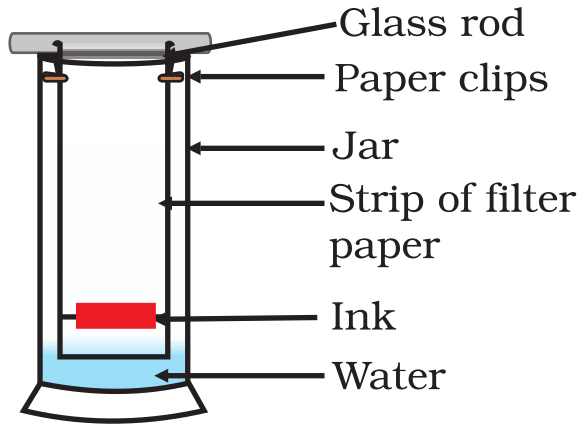
A child wanted to separate the mixture of dyes constituting a sample of ink. He marked a line by the ink on the filter paper and placed the filter paper in a glass containing water as shown in the filter paper was removed when the water moved near the top of the filter paper.
  1. What would you expect to see, if the ink contains three different coloured components?
  2. Name the technique used by the child.
  3. Suggest one more application of this technique.
Calculate the number of molecules in 4g of oxygen.
Nucleus of an atom is positively charged and electrons around it are negatively charged. Then why do electrons not just fall to the nucleus out of attraction?
Define the following terms:
Cell, prokaryotic cell, eukaryotic cell, organelle.
How does the weight of an object vary with respect to mass and radius of the earth. In a hypothetical case, if the diameter of the earth becomes half of its present value and its mass becomes four times of its present value, then how would the weight of any object on the surface of the earth be affected?