Question
Write down energy-losses in transformer.

Answer

Energy losses in transformer: (i) Copper loss, (ii) Iron loss, (iii) Hysteresis loss, (iv) Magentic loss, (v) Humming loss.

Need a full question paper?

Generate a complete, print-ready paper with questions like this in minutes — across 16+ boards, with answer keys.
Start Generating Free

Similar questions

In the phenomenon of interference, write the value of path difference of superimposed waves at the places where constructive and destructive interference occurs.
What type of semiconductor will be obtained when pure Si crystal is doped with indium (In)?
Write the name of that part of electromagnetic spectrum with which electromagnetic waves of following wavelength associated. Write them in descending order of wavelength.
(a) $\lambda_1$ : used in treatment of muscular strains
(b) $\lambda_2$ : used in radio transmission
(c) $\lambda_3$ : used to detect fracture in bones
(d) $\lambda_4:$ are absorbed by ozone layer in the atmosphere
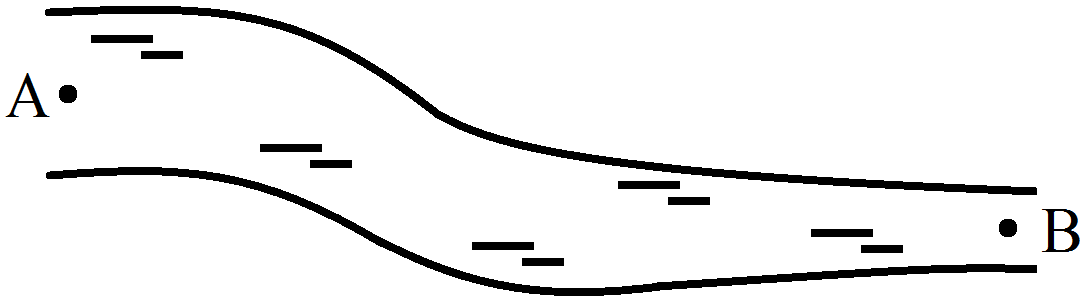
Water flows through a tube shown in The areas of cross$-$section at $A$ and $B$ are $1\ cm^2$ and $0.5\ cm^2$ respectively. The height difference between $A$ and $B$ is $5\ cm$. If the speed of water at $A$ is $10\ cm/s$ find.
  1. The speed at $B$.
  2. The difference in pressures at $A$ and $B$.
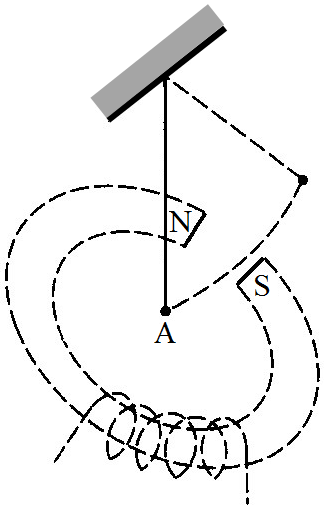
A metallic bob A oscillates through the space between the poles of an electromagnet. The oscillations are more quickly damped when the circuit is on, as compared to the case when the circuit is off. Explain.
On what factors is induced current in a coil depends?
What is the average power given by an ac source to a capacitor?
Water flows at a speed of $6\ cm/s$ through a tube of radius $1\ cm.$ Coefficient of viscosity of water at room termperature is $0.01$ poise. Calculate the Reynolds number. Is it a steady flow?
A charged particle moving with a uniform velocity enters a magnetic field directed perpendicular to it, what will be the path of electron? How will its speed be affected?
Write phase difference between applied emf and current in pure resistor, inductor and capacitor.