Question
Write down the difference between forward bias and reverse bias of $p-n$ junction diode.

Answer

Forward BiasReverse Bias
$p$ - type semiconductor of $p-n$ junction is connected to positive terminal and $n$ - type is connected with negative terminal of battery. Such a biasing is called forward biasing.$p$ - type semiconductor of $p-n$ junction is connected to negative terminal and $n$ - type is connected with positive terminal of battery. Such a biasing is called reverse biasing.
In forward bias, the current is due to majority charge carriers.In Reverse bias, the current is due to minority charge carriers.
Current obtained in forward bias is of the order of $m A$.Current obtained in Reverse bias is of the order of $\mu A$.
When diode is connected in forward bias, width of its depletion layer and height of potential barrier reduces.When diode is connected in reverse bias, width of its depletion layer and height of potential barrier increases.
Resistance is of the order of $10 \Omega$ to $100 \Omega$.Resistance is of the order of $10 M \Omega$.

Need a full question paper?

Generate a complete, print-ready paper with questions like this in minutes — across 16+ boards, with answer keys.

Start Generating Free

Similar questions

The magnetic force depends on v which depends on the inertial frame of reference. Does then the magnetic force differ from inertial frame to frame? Is it reasonable that the net acceleration has a different value in different frames of reference?
Calculate the mass of an $\alpha-$particle. Its binding energy is $28.2MeV.$
Draw a graph from the following data. Draw tangents at $x = 2, 4, 6$ and $8.$ Find the slopes of these tangents. Verify that the curve drawn is $y = 2x^2$ and the slope of dy tangent is $\tan\theta=\frac{\text{dy}}{\text{dx}}=4\text{x}.$
$x$ $1$ $2$ $3$ $4$ $5$ $6$ $7$ $8$ $9$ $10$
$y$ $2$ $8$ $18$ $32$ $50$ $72$ $98$ $128$ $162$ $200$
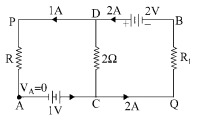
In the given figure, point A is at zero potential. Use Kirchhoff's rules to find out the potential at B.
Image
The susceptibility of a magnetic material is $–2.6 \times 10^{–5}$. Identify the type of magnetic material and state its two properties.
The energy gaps in the energy band diagrams of a conductor, semiconductor and insulator are $E_1, E_2$ and $E_3.$ Arrange them in increasing order.
From what electric dipole of electric field is found and for which two cases is the result simple?
Two loudspeakers are arranged facing each other at some distance. Will a person standing behind one of the loudspeakers clearly hear the sound of the other loudspeaker or the clarity will be seriously damaged because of the 'collision' of the two sounds in between?
In order to have a current in a long wire, it should be connected to a battery or some such device. Can we obtain the magnetic due to a straight, long wire by using Ampere's law without mentioning this other part of the circuit?
What is magnetisation ? Derive the relationship between magnetisation and magnetic intensity.