Question
Write down the difference between SN1 and SN2 reaction.
| SN2 Reaction | SN1 Reaction |
| → SN2 reaction means it is bimolecular nucleophilic substitution reaction. | → SN1 reaction means it is unimolecular nucleophilic substitution reaction. |
| → The rate of SN2 reaction depends on the concentration of Substrate and Nucleophiles both. Rate = K [S]1. [Nu]1 | →The rate of SN1 reaction depends on the concentration of Substrate on Rate = K [S]1 |
| → SN2 reaction follow second order kinetics. | → SN1 reaction follows first order kinetics. |
→ The reaction of chloromethane and hydroxide ion gives methanol and chloride ion is example of SN2 reaction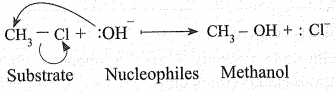 | →The reaction of tert-butyl bromide with hydroxide ion gives tert-butyl alcohol is example of SN1 reaction.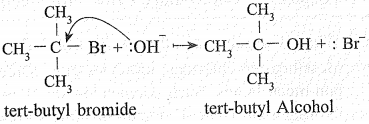 |
| → SN2 reaction complete in a single step without formation of an intermediate | → SN1 reaction complete in twosteps. Step 1: Formation of carbocation by cleavage of CX in haloalkane Step 2: Attack of nucleophiles on carbocation to form product. |
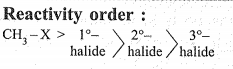 | 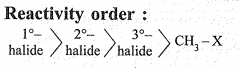 |
| → SN2 reaction shows inversion of configuration. | → SN1 reaction shows reacemic mixture. |
Generate a complete, print-ready paper with questions like this in minutes — across 16+ boards, with answer keys.
| 100 x xacetone | 0 | 11.8 | 23.4 | 36.0 | 50.8 | 58.2 | 64.5 | 72.1 |
| pacetone/ mm Hg | 0 | 54.9 | 110.1 | 202.4 | 322.7 | 405.9 | 454.1 | 521.1 |
| pchloroform/ mm Hg | 632.8 | 548.1 | 469.4 | 359.7 | 257.7 | 193.6 | 161.2 | 120.7 |
