Rajasthan BoardEnglish MediumSTD 12 SciencePhysicsELECTROMAGNETIC WAVES2 Marks
Question
Write down the equation of displacement current and derive the Ampere$-$Maxwell's law.
✓
Answer
$\rightarrow $ Displacement Current $i_d=\varepsilon_0 \frac{d \phi_E}{d t}$ but $\phi_{ E }= AE$
$\therefore i_d=\varepsilon_0 A \frac{d E }{d t}$
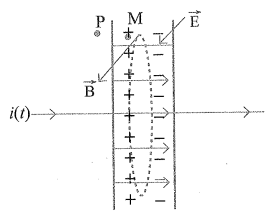
$\rightarrow $ Fig. shows the electric and magnetic fields inside the parallel plate capacitor discussed above. At point $M$ shown in the fig., both these fields are normal to each other.
$\rightarrow $ As per the generalisation made by Maxwell, the source of magnetic field is not just the conduction electric current due to flowing charges, but also the time rate of change of electric field.
$\rightarrow $ Which means, the total current $i$ is the sum of conduction current $\left(i_{ c }\right)$ and the displacement
$\begin{array}{l}\text { current }\left(i_{ d }\right)\left(\text { where } i_{ d }=\varepsilon_{ o } \frac{d \phi_E}{d t}\right) \text {. } \\\quad i=i_{ C }+i_{ d } \\\therefore i=i_{ C }+\varepsilon_{ o } \frac{d \phi_E}{d t} \\\therefore i=i_{ C }+\varepsilon_{ o } A \frac{d E }{d t}......(1)\end{array}$
$\rightarrow $ Eq. $(1)$ can be interpreted as follows :
Outside the capacitor plates, we have only conduction current $i_{ c }=i$ and no displacement current $i_{ d }=0$. On the other hand, inside the capacitor, there is no conduction current, i.e. $i_{ c }=0$, and there is only displacement current, so that $i_{ d }=i$.
$\rightarrow $ The generalised (and correct) form of Ampere's circuital law is
$\oint \overrightarrow{ B } \cdot \overrightarrow{d l}=\mu_0 i(t)$
$($But there is a difference; "The total current passing through any surface of which the closed loop is the perimeter" is the sum of the conduction current and the displacement current.$)$ Generalised law is :
$\begin{array}{l}\therefore \oint \overrightarrow{ B } \cdot \overrightarrow{d l}=\mu_0\left(i_c+i_{ d }\right) \\\therefore \oint \overrightarrow{ B } \cdot \overrightarrow{d l}=\mu_0\left(i_c+\varepsilon_0 \frac{d \phi}{d t}\right) \\\therefore \oint \overrightarrow{ B } \cdot \overrightarrow{d l}=\mu_0 i_c+\mu_0 \varepsilon_0 \frac{d \phi}{d t}\end{array}$
$\rightarrow $ This equation is known as Ampere$-$Maxwell law.
$\rightarrow $ Ampere-Maxwell law : "The total current passing through any surface of which the closed loop is the perimeter, is the sum of conduction current and the displacement current."
Need a full question paper?
Generate a complete, print-ready paper with questions like this in minutes — across 16+ boards, with answer keys.