Question
Write down the equation of electric potential for a point - outside the spherical shell - on the surface of a spherical shell and - inside the spherical shell.
Answer

Generally, for a spherical shell, the electric field for a point outside the surface of shell is such that the entire charge of shell can be considered as concentrated at its centre.
The value of electric potential that we get for a point outside the surface of shell is also got (derived) in a similar way.
$V =\frac{1}{4 \pi \varepsilon_0} \cdot \frac{q}{r}(r \geq R )$

Where, $q$ - total electric charge on the shell
R - radius of the shell
$r$ - the distance of the point from the centre of the shell.

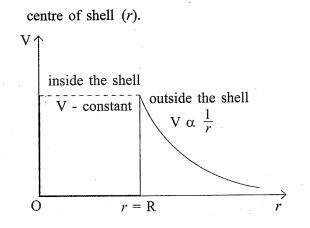
The electric field inside the shell is zero, therefore potential inside remains constant.
Because as there is no electric field inside, the work done in taking the charge from one point to the other is zero.

$\begin{array}{l}
\therefore \text { In } W =q \Delta V , \\
\text { because } W =0 \\
\therefore \Delta V =0 \\
\therefore V =\text { constant }
\end{array}$

and that value of potential is same as the value on the surface of shell.
$\therefore V =\frac{1}{4 \pi \varepsilon_0} \cdot \frac{q}{ R } \quad(\because r \leq R )$

Below figure (graph) shows the variation of electric potential $( V )$ versus distance from the

Image

Need a full question paper?

Generate a complete, print-ready paper with questions like this in minutes — across 16+ boards, with answer keys.

Start Generating Free

Similar questions

57Co decays to 57Fe by $\beta^+-\text{ emission.}$- emission. The resulting 57Fe is in its excited state and comes to the ground state by emitting $\gamma-\text{rays}.$ The half-life of $\beta^+-\text{decay}$ is 270 days and that of the $\gamma-\text{emissions}$ is 10-8 s. A sample of 57Co gives 5.0 × 10⁹ gamma rays per second. How much time will elapse before the emission rate of gamma rays drops to 2.5 × 10⁹per second?
Electrons are emitted from the surface when green light is incident on it, but no electrons are ejected when yellow light is incident on it. Do you expect electrons to be ejected when surface is exposed to (i) Red light and (ii) Blue light?
What is the resistance of an intrinsic semiconductor at 0K?
The radius of the innermost electron orbit of a hydrogen atom is 5.3×10⁻¹¹ m. What are the radii of the n = 2 and n = 3 orbits?
Plot a graph showing the variation of stopping potential with the frequency of incident radiation for two different photosensitive materials having work functions W1 and W2 (W1 > W2). On what factors does the (i) slope and (ii) intercept of the lines depend?
The image of a small electric bulb fixed on the wall of a room is to be obtained on the opposite wall 3 m away by means of a large convex lens. What is the maximum possible focal length of the lens required for the purpose?
Answer the following question:
In viewing through a magnifying glass, one usually positions one’s eyes very close to the lens. Does angular magnification change if the eye is moved back?
What is doping ? - Explain.
If the sound level in a room is increased from 50dB to 60dB, by what factor is the pressure amplitude increased?
A person is painting his house walls. He stands on a ladder with a bucket containing paint in one hand and a brush in other. Suddenly the bucket slips from his hand and falls down on the floor. If the bucket with the paint had a mass of 6.0kg and was at a height of 2.0m at the time it slipped, how much gravitational potential energy is lost together with the paint?