Question
Write down the equation of the line whose gradient is $\frac{3}{2}$and which passes through P. where P divides the line segment joining $A(−2, 6)$ and $B(3, −4)$ in the ratio $2 : 3$

Answer

Given, P divides the line segment joining A $(−2, 6)$ and B $(3, −4)$ in the ratio $2: 3.$ Co-ordinates of point P are
$\left(\frac{2 \times 3+3 \times(-2)}{2+3}, \frac{2 \times(-4)+3 \times 6}{2+3}\right)$
$ =\frac{6-6}{5}, \frac{-8+18}{5}$
$=\frac{6-6}{5}, \frac{-8+18}{5}$
$ =(0.2)=\left(x_1, y_1\right)$
Slope of the required line $= m =\frac{3}{2}$
The required equation of the line is given by
$y − y_1 = m (x − x_1)$ 
$y-2=\frac{3}{2}(x-0)$
$2y − 4 = 3x$
$2y = 3x + 4$  

Need a full question paper?

Generate a complete, print-ready paper with questions like this in minutes — across 16+ boards, with answer keys.
Start Generating Free

Similar questions

A circle with diameter $20 \ cm$ is drawn somewhere on a rectangular piece of paper with length $40 \ cm$ and width $30 \ cm.$ This paper is kept horizontal on table top and a die, very small in size, is dropped on the rectangular paper without seeing towards it. If the die falls and lands on paper only, find the probability that it will fall and land: outside the circle
Prove that $A(4, 3), B(6, 4), C(5, 6)$ and $D(3, 5)$ are the angular points of a square.
The triangle $A B C$, where $A$ is $(2,6), B$ is $(-3,5)$ and $C$ is $(4,7)$, is reflected in the $y$-axis to triangle $A^{\prime} B^{\prime} C^{\prime}$. Triangle $A^{\prime} B^{\prime} C^{\prime}$ is then reflected in the origin to triangle $A^{\prime \prime} B^{\prime \prime} C^{\prime \prime}$.
i. Write down the co-ordinates of $A ^{\prime \prime}, B ^{\prime \prime}$ and $C ^{\prime \prime}$.
ii. Write down a single transformation that maps triangle $A B C$ onto triangle $A^{\prime \prime} B^{\prime \prime} C^{\prime \prime}$.
Calculate the percentage income in the following investment:
Rs 7,225 paying 12% when a Rs 100 share is available at 15% discount.
A man bought an article for Rs x and sold it for Rs $16.$ If his loss was x per cent, find the cost price of the article.
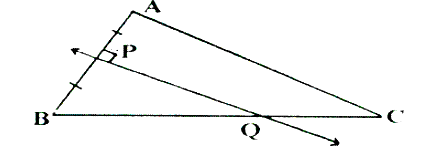
Given: PQ is perpendicular bisector of side AB of the triangle ABC.

Prove: Q is equidistant from A and B.
Construct the locus of points inside the triangle ABC, which are equidistant from B and C. Mark the point P which is equidistant from AB, BC and also equidistant from B and C.
If the points $A (6,1), B (8,2), C (9,4)$ and $D (p, 3)$ are the vertices of a parallelogram, taken in order, find the value of $p$.
Given the matrices $A=\left[\begin{array}{ll}2 & 1 \\ 4 & 2\end{array}\right], B=\left[\begin{array}{cc}3 & 4 \\ -1 & -2\end{array}\right]$ and $C=\left[\begin{array}{cc}-3 & 1 \\ 0 & -2\end{array}\right]$ Find $1) \ce{ABC}, 2) \ce{ACB}$ State whether $\ce{ABC = ACB}.$
The sum of two numbers is $9$ and the sum of their squares is $41$. Taking one number as x, form ail equation in x and solve it to find the numbers.