Question
Write Einstein's photoelectric equation and explain any two observations related to the photoelectric effect.

Answer

The photoelectric equation of Einstein,
$\frac{1}{2} mv _{\max }^2= hv -\phi_0$
Observations related to photoelectric effect:
(1) On frequency of incident light is less than the threshold frequency or $v<v_0$ then from equation $\frac{1}{2} \operatorname{mv}_{\max }^2= h \left(v-v_0\right)$, the value of kinetic energy of electron will be negative since kinetic energy is negative. So if $v<v_0$ emission of photo-electrons is not possible, i.e. the frequency of incident light must be greater than or equal to the threshold frequency.
(2) The number of electrons emitted depends on the number of incident photons. In other words, we can say that the number of electrons emitted in unit time for light of fixed frequency from unit area of surface, depends on the number of photons incident on unit area in unit time on the surface i.e. the intensity of light.
(3) From eq. $\frac{1}{2} m v_{\max }^2=h\left(v-v_0\right)$ it is clear that kinetic energy of emitted photoelectrons depends on the frequency of the incident proton but not on the intensity of light.
(4) According to quantum theory, energy of light remains in the form of photons. Therefore as soon as a photon of sufficient energy strikes on the surface, an electron is emitted due to the absorptions, i.e. there is no time lag in the emission of photoelectrons.

Need a full question paper?

Generate a complete, print-ready paper with questions like this in minutes — across 16+ boards, with answer keys.

Start Generating Free

Similar questions

A point object 'O' is kept in a medium of refractive index n1 in front of a convex spherical surface of radius of curvature R which separates the second medium of refractive index n2 from the first one, as shown in the figure.
  1. Draw the ray diagram showing the image formation and deduce the relationship between the object distance and the image distance in terms of n1, n2 and R.
  2. When the image formed above acts as a virtual object for concave spherical, surface separating the medium n2 from n1 (n2> n1), draw this ray diagram and write the similar (similar to (a) relation. Hence obtain the expression for the lens maker's formula.
Nuclei with magic no. of proton Z = 2, 8, 20, 28, 50, 52 and magic no. of neutrons N = 2, 8, 20, 28, 50, 82 and 126 are found to be very stable.

  1. Verify this by calculating the proton separation energy Sp for 120Sn (Z = 50) and 121Sb = (Z = 51). The proton separation energy for a nuclide is the minimum energy required to separate the least tightly bound proton from a nucleus of that nuclide. It is given by,

Sp = (MZ-1' N + MH - MZ,N) c2.

Given 119In = 118.9058u, 120Sn = 119.902199u, 121Sb = 120.903824u, 1H = 1.0078252u.
  1. What does the existance of magic number indicate?
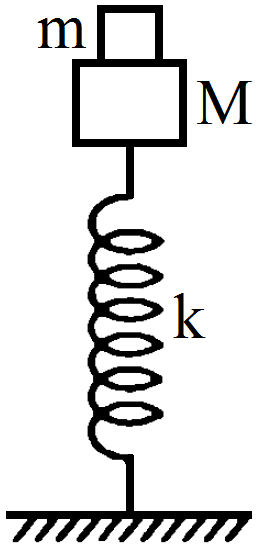
A small block of mass m is kept on a bigger block of mass M which is attached to a vertical spring of spring constant k as shown in the figure. The system oscillates vertically.
  1. Find the resultant force on the smaller block when it is displaced through a distance x above its equilibrium position.
  2. Find the normal force on the smaller block at this position. When is this force smallest in magnitude?
  3. What can be the maximum amplitude with which the two blocks may oscillate together?

A beam of white light is incident normally on a plane surface absorbing 70% of the light and reflecting the rest. If the incident beam carries 10W of power, find the force exerted by it on the surface.
A converging lens of focal length 15cm and a converging mirror of focal length 10cm are placed 50cm apart with common principal axis. A point source is placed in between the lens and the mirror at a distance of 40cm from the lens. Find the locations of the two images formed.
There are two sources of light, each emitting with a power of 100W. One emits X-rays of wavelength 1nm and the other visible light at 500nm. Find the ratio of number of photons of X-rays to the photons of visible light of the given wavelength?
A long wire carrying a current i is bent to form a plane angle $\alpha.$ Find the magnetic field B at a point on the bisector of this angle situated at a distance x from the vertex.
A coil of resistance $40\Omega$ is connected across a 4.0V battery 0.10s after the battery is connected, the current in the coil is 63mA. Find the inductance of the coil.
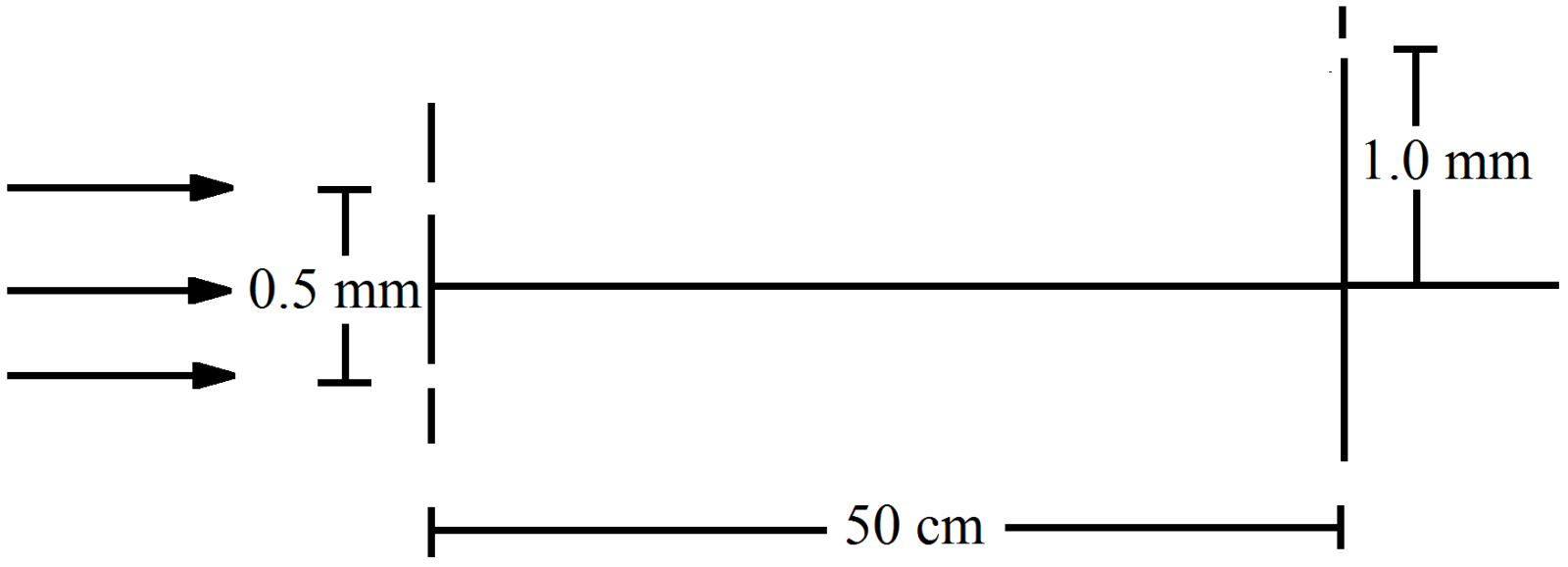
White coherent light (400nm - 700nm) is sent through the slits of a Young's double slit experiment (figure.) The separation between the slits is 0.5mm and the screen is 50cm away from the slits. There is a hole in the screen at a point 1.0mm away (along the width of the fringes) from the central line.
  1. Which wavelength (s) will be absent in the light coming from the hole?
  2. which wavelength (s) will have a strong intensity?

A compound microscope consists of an objective of focal length 1cm and an eyepiece of focal length 5cm. An object is placed at a distance of 0.5cm from the objective. What should be the separation between the lenses so that the microscope projects an inverted real image of the object on a screen 30cm behind the eyepiece?