Question
Write Einstein's photoelectric equation and explain each term used in it.

Answer

Einstein's Photoelectric Equation :
$ E_{k}=hv-W $
Where $ hv $ = Energy of photon incident on metal surface in
which $ h $= Planck's constant, and $ v $= frequency of the photon
$ W $= Work function of the metal
$ E_{k} $= Maximum kinetic energy of emitted photo-electron.
The above equation can also be written in the following form:
$ \frac{1}{2}mv_{max}^{2}=h(v-v_{0}) $
where $m$ = mass of the emitted photoelectron, $ V_{max} $ = maximum velocity of emitted photoelectron, $ v_{0} $= Threshold frequency of the metal; $ v $= frequency of incident photon; and $h$ = Planck's constant.

Need a full question paper?

Generate a complete, print-ready paper with questions like this in minutes — across 16+ boards, with answer keys.

Start Generating Free

Similar questions

Suppose a monochromatic X-ray beam of wavelength 100pm is sent through a Young's double slit and the interference pattern is observed on a photographic plate placed 40cm away from the slit. What should be the separation between the slits so that the successive maxima on the screen are separated by a distance of 0.1mm?
A charge $q$ is placed at the centre of the line joining two equal charges $Q.$
Show that the system of three charges will be in equilibrium if $\text{q}=-\frac{\text{Q}}{4}.$
In the original Fizeau method, the light travelled 8.6km and then returned. What could be the difficulty if this distance is taken as 8.6m?
  1. Draw a ray diagram for the formation of image by a compound microscope.
  2. You are given the following three lenses. Which two lenses will you use as an eyepiece and as an objective to construct a compound microscope?
Lenses Power $(D)$ Aperture $(cm)$
$L_1$ $3$ $8$
$L_2$ $6$ $1$
$L_3$ $10$ $1$
  1. Define resolving power of a microscope and write one factor on which it depends.
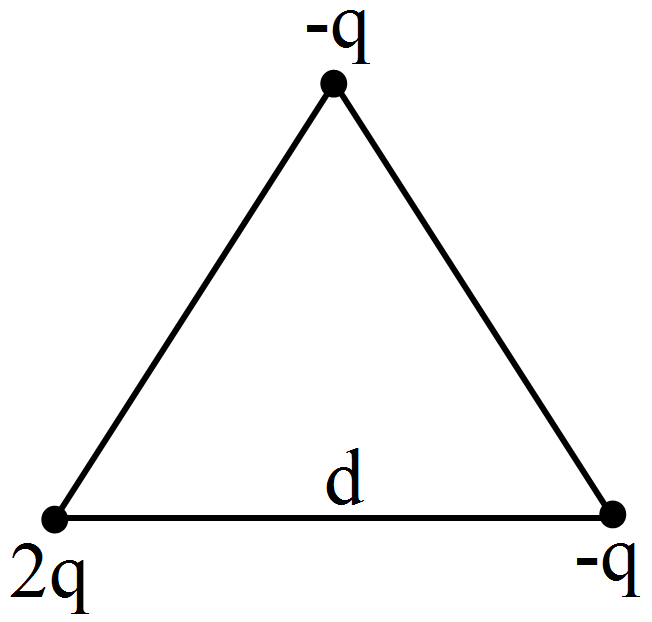
Three charges are arranged on the vertices of an equilateral triangle as shown in figure. Find the dipole moment of the combination.
A source of $ac$ voltage $v = v_0 \sin\omega t,$ is connected across a pure inductor of inductance $L$. Derive the expressions for the instantaneous current in the circuit. Show that average power dissipated in the circuit is zero.
One end of a steel rod $(\text{K}=46\text{Js}^{-1}\text{m}^{-1}{^{\circ}}\text{C}^{-1})$ of length $1.0m$ is kept in ice at $0^\circ C$ and the other end is kept in boiling water at $100^\circ C$. The area of cross section of the rod is $0.04\ cm^2$. Assuming no heat loss to the atmosphere, find the mass of the ice melting per second. Latent heat of fusion of ice $=3.36\times10^5\text{Jkg}^{-1}.$
The radius of innertmost orbit of hydrogen atom is $5.3 \times 10^{-11} m$. What is the radius of second excited state?
A bar magnet of magnetic moment 6J/T is aligned at 60° with a uniform external magnetic field of 0·44T. Calculate (a) the work done in turning the magnet to align its magnetic moment (i) normal to the magnetic field, (ii) opposite to the magnetic field, and (b) the torque on the magnet in the final orientation in case (ii).
Estimate the proportion of boron impurity whieh will increase the conductivity of a pure silicon sample by a factor of $100$. Assume that each boron atom creates a hole and the concentration of holes in pure silicon at the same temperature is $7 \times 10^{15}$ holes per cubic metre. Density of silicon is $5 \times 10^{21}$ atoms per cubic metre.