Question
Write Einstein’s photoelectric equation. State clearly the three salient features observed in photoelectric effect, which can be explained on the basis of the above equation.

Answer

Einstein’s photoelectric equation$:$
$\text{K}_{max} = \text{hv} - \phi_{0} = \text{h}(\text{v} - \text{v}_{0})$
  1. $K_{max}$ of electrons depends linearly on $v.$
  2. $K_{max}$ is independent of intensity of radiation.
  3. There exists a threshold frequency $\text{v}_{0}\it{( = \phi_{0}/\text{h})}$ for the metal surface, below which no photoelectric emission is possible. $($No matter how intense the incident radiation may be or how long it falls on the surface$.)$
  4. For $v > v_0,$ photoelectric current is proportional to intensity of incident radiations.

Need a full question paper?

Generate a complete, print-ready paper with questions like this in minutes — across 16+ boards, with answer keys.
Start Generating Free

Similar questions

Find the intensity at a point on a screen in Young’s double slit experiment where the interfering waves have a path difference of (i) $\lambda/6$, and (ii) $\lambda/2.$
Represent the Electric field and Magnetic field seen in the Electro magnetic waves $(EM$ waves$)$ in the form of equation.
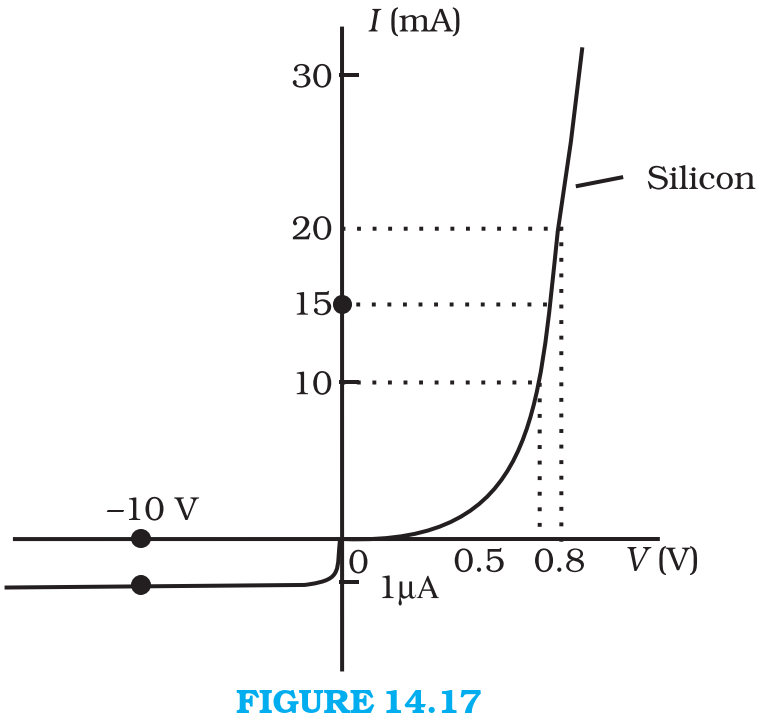
The $V-I$ characteristic of a silicon diode is shown in the Fig. 14.17. Calculate the resistance of the diode at (a) $I_D=15 mA$ and (b) $V_D=-10 V$.
Image
A block of mass 5.0kg slides down an incline of inclination 30° and length 10m. Find the work done by the force of gravity.
A circular loop of one turn carries a current of 5.00A. If the magnetic field B at the centre is 0.200mT find the radius of the loop.
A proton and a deuteron are accelerated through the same accelerating potential. Which one of the two has,
  1. greater value of de$-$Broglie wavelength associated with it, and
  2. less momentum?
Give reasons to justify your answer.
  1. The mass of a nucleus in its ground state is always less than the total mass of its constituents - neutrons and protons. Explain.
  2. Plot a graph showing the variation of potential energy of a pair of nucleons as a function of their separation.
Ultraviolet light is incident on two photosensitive materials having work functions $W_1$ and $W_2 \ (W_1 > W_2).$ In which case will the kinetic energy of the emitted electrons be greater? Why?
The decay constant of $\text{ }^{197}_{80}\text{Hg} ($electron capture to $\text{ }^{197}_{79}\text{Au})$ is $1.8 \times 10^{-4} S^{-1}.$
  1. What is the half-life$?$
  2. What is the average-life$?$
  3. How much time will it take to convert $25\%$ of this isotope of mercury into gold$?$
Electrons are emitted from an electron gun at almost zero velocity and are accelerated by an electric field $E$ through a distance of $1.0m.$ The electrons are now scattered by an atomic hydrogen sample in ground state. What should be the minimum value of $E$ so that red light of wavelength $656.3\ nm$ may be emitted by the hydrogen?