Question
Write Faraday's laws of electromagnetic induction and derive them.

Answer

SELF

Need a full question paper?

Generate a complete, print-ready paper with questions like this in minutes — across 16+ boards, with answer keys.
Start Generating Free

Similar questions

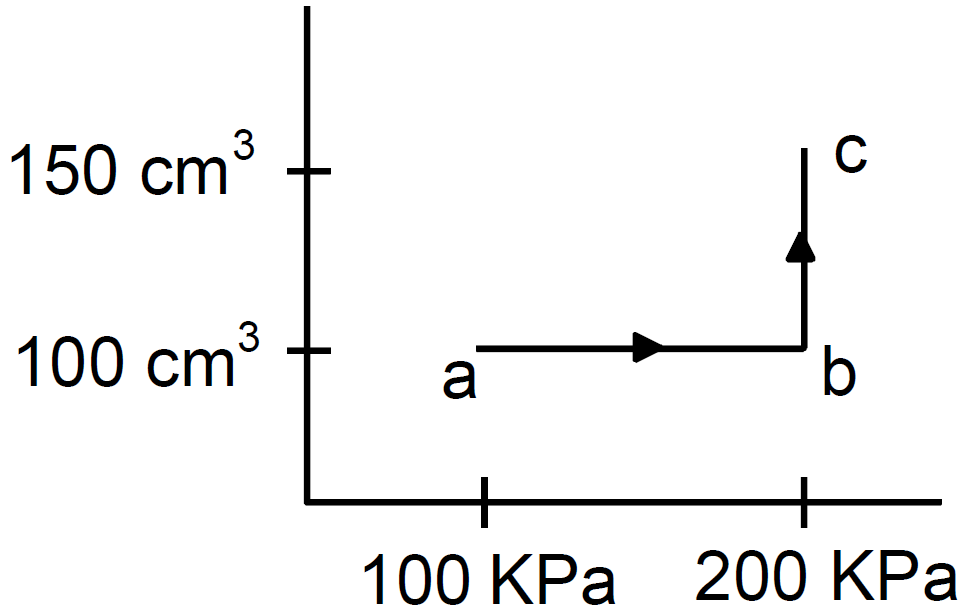
An ideal gas $(\gamma=1.67)$ is taken through the process abc shown in the figure. The temperature at point a is $300K$. Calculate,
  1. The temperatures at $b$ and $c.$
  2. The work done in the process.
  3. The amount of heat supplied in the path ab and in the path bc.
  4. The change in the internal energy of the gas in the process.
A thin lens made of a material of refractive index $\mu_2$ has a medium of refractive index $\mu_1$ on one side and a medium of refractive index $\mu_3$ on the other side. The lens is biconvex and the two radii of curvature have equal magnitude $R.$ A beam of light travelling parallel to the principal axis is incident on the lens. Where will the image be formed if the beam is incident from:
  1. The medium $\mu_1$
  2. From the medium $\mu_3?$
A thermally insulated, closed copper vessel contains water at $15^\circ C$. When the vessel is shaken vigorously for $15$ minutes, the temperature rises to $l 7^\circ C$. The .mass of the vessel is $100g$ and that of the water is $200g$. The specific heat capacities of copper and water are $420\ J\ kg^{-1} K^{-1}$ and $4200\ J\ kg^{-1} K^{-1}$ respectively. Neglect any thermal expansion.
  1. How much heat is transferred to the liquid-vessel system?
  2. How much work has been done on this system?
  3. How much is the increase in internal energy of the system?
An $X-$ray tube operates at $40kV.$ Suppose the electron converts $70\%$ of its energy into a photon at each collision. Find the lowest there wavelengths emitted from the tube. Neglect the energy imparted to the atom with which the electron collides.
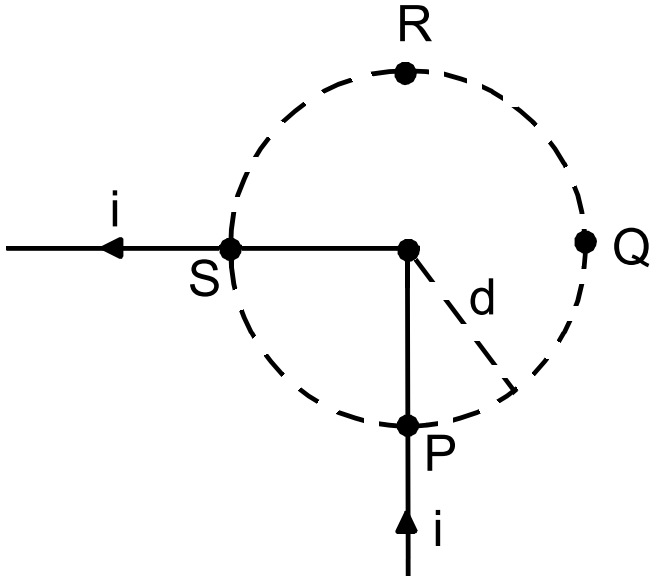
Figure shows a long wire bent at the middle to form a right angle. Show that the magnitudes of the magnetic fields at the points $P, Q, R$ and $S$ are equal and find this magnitude.
A paisa coin is made up of $Al-Mg$ alloy and weighs $0.75g$. It has a square shape and its diagonal measures $17\ mm.$ It is electrically neutral and contains equal amounts of positive and negative charges.
Treating the paisa coins made up of only Al, find the magnitude of equal number of positive and negative charges. What conclusion do you draw from this magnitude?
Derive Snell's law for refraction of light by Huygen's wave theory.
What is Zener diode? Give its symbolic diagram. Draw its (I-V) characteristic curve. Explain its use as a voltage regulator ?
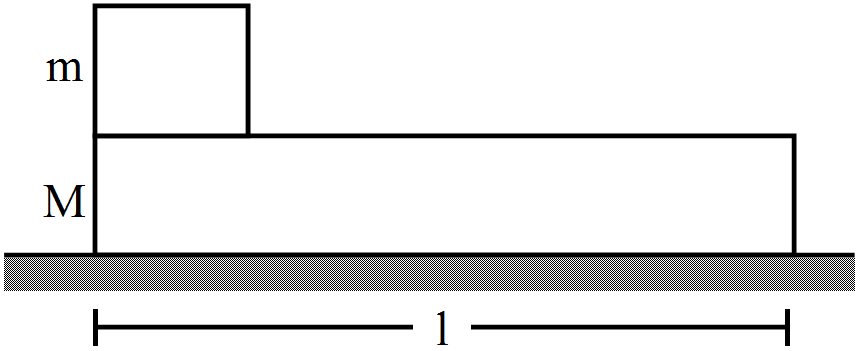
Figure shows a small block of mass m kept at the left end of a larger block of mass $M$ and length $l.$ The system can slide on a horizontal road. The system is started towards right with an initial velocity $v.$ The friction coefficient between the road and the bigger block is $g$ and that between the block is $\frac{\mu}{2}.$ Find the time elapsed before the smaller blocks separates from the bigger block.
A thin prism of angle $6.0^\circ,\omega=0.07$ and $\mu_\text{y}=1.50$ is combined with another thin prism having $\omega=0.08$ and $\mu_\text{y}=1.60.$ The combination produces no deviation in the mean ray.
  1. Find the angle of the second prism.
  2. Find the net angular dispersion produced by the combination when a beam of white light passes through it.
  3. If the prisms are similarly directed, what will be the deviation in the mean ray
  4. Find the angular dispersion in the situation described in (c).