Question
Write first and second postulates of Bohr's Atomic Model. Obtain the expression for radius and velocity of stable orbit of electron.###Explain Bohr's two postulates for hydrogen atom.

Answer

Bohr's postulates : Bohr proposed three postulates which are following :
(1) Bohr's first postulates : Any electron can revolve in the definite stable states of atom without radiating the emission energy. It is opposite to the electromagnetic principle. According to this postulate, each atom has same definite stable states in which it existed and existed total energy is definite in all possible states. All these possible states are called stable states of atom.
(2) Bohr's second postulate : Second postulate defines to these stable orbit. According to this postulate, electron revolves around the nucleus only in those orbits for which angular momentum is multiple integer of $\frac{h}{2 \pi}$. Where, $h$ Planck's constant $\left(=6.6 \times 10^{-34} Js \right)$. Therefore, L is quantised angular momentum of revolving electron. That is,
$L=\frac{n h}{2 \pi}$ $\ldots (1)$
(3) Bohr's third postulate : According to this postulate, transition of electron can be done from specially given unradiated orbits to second low energy orbits. When it does so a photon is emitted, whose energy is equal to the difference of energy of initial and final states. Frequency of emitted photon is given by following expression :
$h v=E_i-E_f$ $\ldots (2)$
Where, $E _i$ and $E _f$ are the energies of initial and final states, $E _i> E _f$
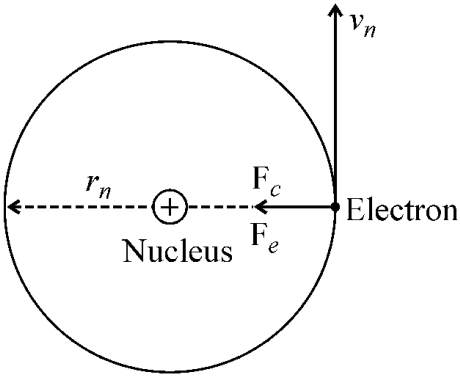
Bohr's Radius or radius of stable orbits : Let $r_n$ is the radius of $n^{\text {th }}$ orbit of any atom and in which an electron is moving with velocity $v_n$. If mass of electron is $m$ then from the Bohr's second postulate,
$m v_n r_n=n \cdot \frac{h}{2 \pi}$ $\ldots (1)$
Image
From Bohr's first postulate,
$F _e = F _c$
$\therefore \frac{1}{4 \pi \epsilon_0} \cdot \frac{Z e^2}{r_n^2}=\frac{m v^2 n}{r_n}$ $\ldots (2)$
From eqn. (1) $v_n=\frac{n h}{2 \pi m r_n}$
Put value of $v_n$ in eqn. (2)
$\frac{1}{4 \pi \epsilon_0} \cdot \frac{ Z e^2}{r_n^2}=\frac{m}{r_n} \times \frac{n^2 h^2}{4 \pi^2 m^2 r_n^2}$
or $\quad \frac{Z e^2}{\epsilon_o}=\frac{n^2 h^2}{r_n \cdot \pi m}$ $\quad$ $\therefore r_n=\frac{\epsilon_0 n^2 h^2}{\pi m Z e^2}$
or $\quad \underline {r_n=\frac{\epsilon_0 h^2}{\pi m Z e^2} \cdot n^2}$ $\ldots (3)$
Speed of electron in stable orbit
$\because \quad v_n=\frac{n h}{2 \pi m r_n}$
Put the value of $r_n$ from eqn. (3)
$v_n=\frac{n h}{2 \pi m\left[\frac{\epsilon_0 h^2 n^2}{\pi m e^2 Z}\right]} \Rightarrow \underline {v_n=\frac{Z e^2}{2 \epsilon_0 h n}}$

Need a full question paper?

Generate a complete, print-ready paper with questions like this in minutes — across 16+ boards, with answer keys.
Start Generating Free

Similar questions

Are the nucleons fundamental particles, or do they consist of still smaller parts? One way to find out is to probe a nucleon just as Rutherford probed an atom. What should be the kinetic energy of an electron for it to be able to probe a nucleon? Assume the diameter of a nucleon to be approximately $10^{-15}m.$
  1. Compare the individual dipole moment and the specimen dipole moment for $H_2O $ molecule and $O_2$ molecule when placed in:
  1. Absence of external electric field.
  2. Presence of external eclectic field. Justify your answer.
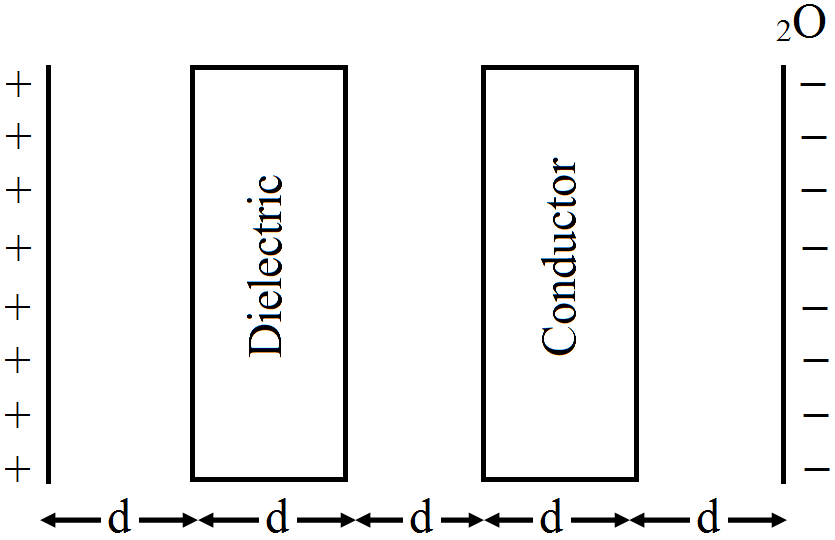
  1. Given two parallel conducting plates of area A and charge densities $+\sigma$ and $-\sigma.$ A dielectric slab of constant K and a conducting slab of thickness d each are inserted in between them as shown.
  1. Find the potential difference between the plates.
  2. Plot E versus x graph, taking x = 0 at positive plate and x = 5d at negative plate.
(i) Obtain an expression for torque acting on a rectangular current carrying coil in a uniform magnetic field. (ii) Calculate magnetic dipole of a circular electric current loop.
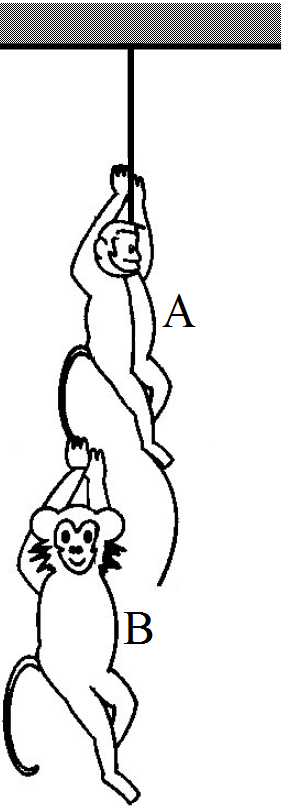
The monkey B shown in figure is holding on to the tail of the monkey A which is climbing up a rope. The masses of the monkeys A and B are 5kg and 2kg respectively. If A can tolerate a tension of 30N in its tail, what force should it apply on the rope in order to carry the monkey B with it? Take $g = 10m/s^2$
An electric field is uniform, and in the positive $x$ direction for positive $x$, and uniform with the same magnitude but in the negative $x$ direction for negative $x$. It is given that $E =200 \hat{ i } N / C$ for $x>0$ and $E =-200 \hat{ i } N / C$ for $x<0$. A right circular cylinder of length $20 \ cm$ and radius $5 \ cm$ has its centre at the origin and its axis along the $x-$ axis so that one face is at $x=+10 \ cm$ and the other is at $x=-10 \ cm\  ($Fig. $1.25).\ (a)$ What is the net outward flux through each flat face? $(b)$ What is the flux through the side of the cylinder? $(c)$ What is the net outward flux through the cylinder? $(d)$ What is the net charge inside the cylinder?
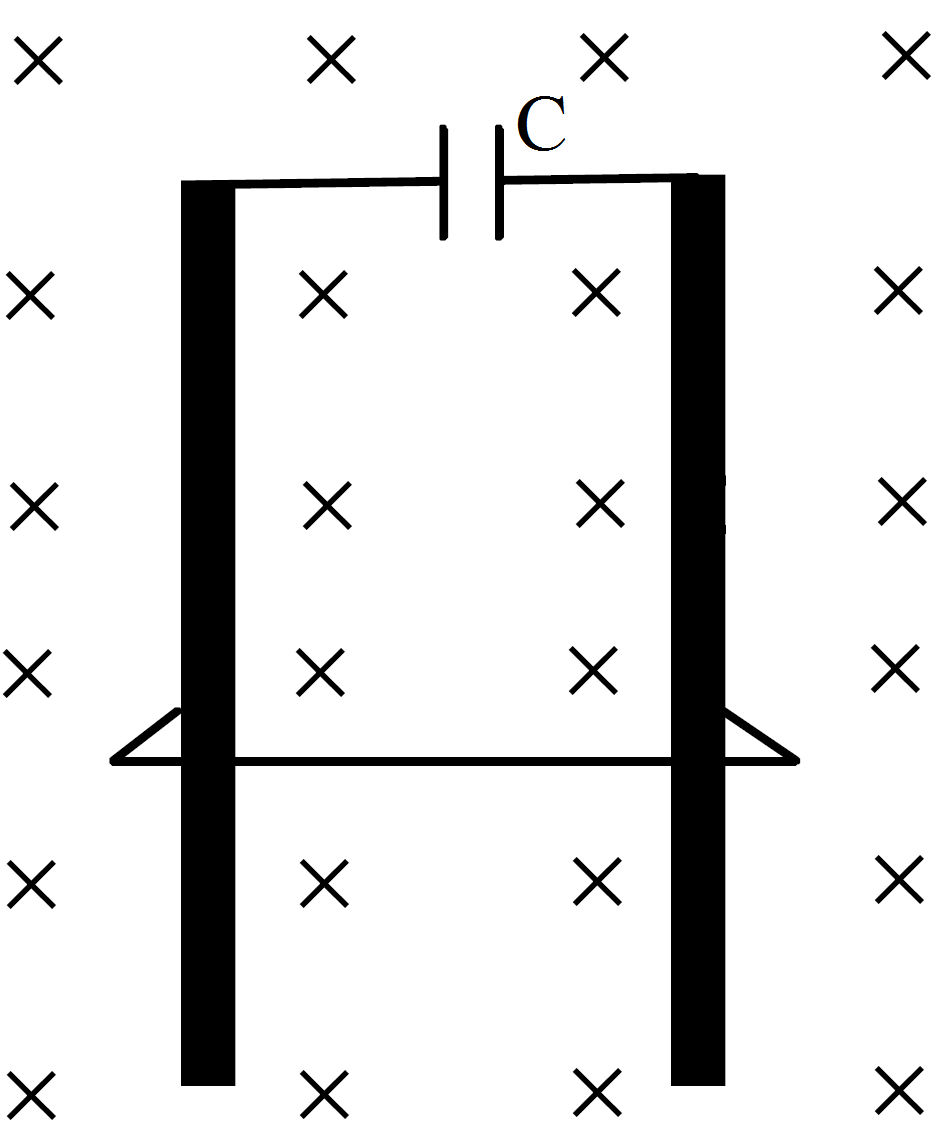
A wire of mass m and length l can slide freely on a pair of smooth, vertical rails (figure). A magnetic field B exists in the region in the direction perpendicular to the plane of the rails. The rails are connected at the top end by a capacitor of capacitance C. Find the acceleration of the wire neglecting any electric resistance.
The equation of motion of a particle started at t = 0 is given by $\text{x}=5\sin\big(20\text{t}+\frac{\pi}{3}\big)$ where x is in centimetre and t in second. When does the particle.
  1. First come to rest.
  2. First have zero acceleration.
  3. First have maximum speed?
The terminology of different parts of the electromagnetic spectrum is given in the text. Use the formula E = hν (for energy of a quantum of radiation: photon) and obtain the photon energy in units of eV for different parts of the electromagnetic spectrum. In what way are the different scales of photon energies that you obtain related to the sources of electromagnetic radiation?
In an experiment on photoelectric effect, the stopping potential is measured for monochromatic light beams corresponding to different wavelengths. The data collected are 11s follows:
wavelength (nm) 350 400 450 500 550
stopping potential(V): 1.45 1.00 0.66 0.38 0.16
Plot the stopping potential against inverse of wavelength $\big(\frac{1}{\lambda}\big) $ on a graph paper and find
  1. The Planck constant,
  2. The work function of the emitter and.
  3. The threshold wavelength.
A metal block of heat capacity $80J^\circ C^{-1} $ placed in a room at 20°C is heated electrically. The heater is switched off when the temperature reaches 30°C. The temperature of the block rises at the rate of $2^\circ Cs^{-1}$ just after the heater is switched on and falls at the rate of $0.2^\circ Cs^{-1}$ just after the heater is switched off. Assume Newton's law of cooling to hold.
  1. Find the power of the heater.
  2. Find the power radiated by the block just after the heater is switched off.
  3. Find the power radiated by the block when the temperature of the block is 25°C.
  4. Assuming that the power radiated at 25°C represents the average value in the heating process, find the time for which the heater was kept on.