Question
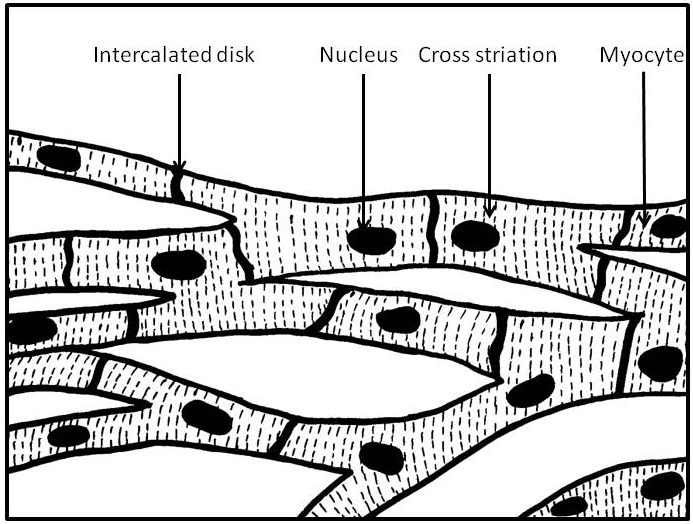
Write important functional differences between striated and smooth muscle tissues. Draw a labeled diagram of the muscle tissue that shows rhythmic contraction and relaxation throughout the life.

Answer


Differences between striated and smooth muscle tissues:
Striated muscle tissues
smooth muscle tissues
Striated muscles are voluntary
smooth muscles are involuntary in function.
Striated muscles show stripes
smooth muscles do not show stripes.
Skeletal muscle fibres are cylindrical
smooth muscle fibres are spindle shaped.
Diagram of the muscle tissue:

Need a full question paper?

Generate a complete, print-ready paper with questions like this in minutes — across 16+ boards, with answer keys.
Start Generating Free

Similar questions

What are cell organelles? Write the names of different cell organelles.
How will you separate common salt, sand and iron filings from their mixture?
A liquid compound $X$ of molecular mass $18u$ can be obtained from a number of natural sources. All the animals and plants need liquid $X$ for their survival. When an electric current is passed through $200$ grams of pure liquid $X$ under suitable conditions, then $178$ grams of gas $Y$ and $22$ grams of gas $Z$ are produced. Gas $Y$ is produced at the positive electrode whereas gas $Z$ is obtained at the negative electrode. Moreover, gas $Y$ supports combustion whereas gas $Z$ burns itself causing explosions.
  1. Name $(i)$ liquid $X$ $(ii)$ gas $Y$, and $(iii)$ gas $Z$
  2. What is the ratio to the mass of element $Z$ to the mass of element $Y$ in the liquid $X$?
  3. Which law of chemical combination is illustrated by this example?
  4. Name two sources of liquid $X$.
  5. Gate an important use of $Y$ in our life.
What is the role of $SER$ in liver cells of vertebrates?
What is the similarity between mitochondria and plastids? Give any two.
Explain the mechanism of compost formation.
Write a short note on prevention of animal diseases.
What does a neuron look like?
Write down the characters of bee variety suitable for bee keeping.
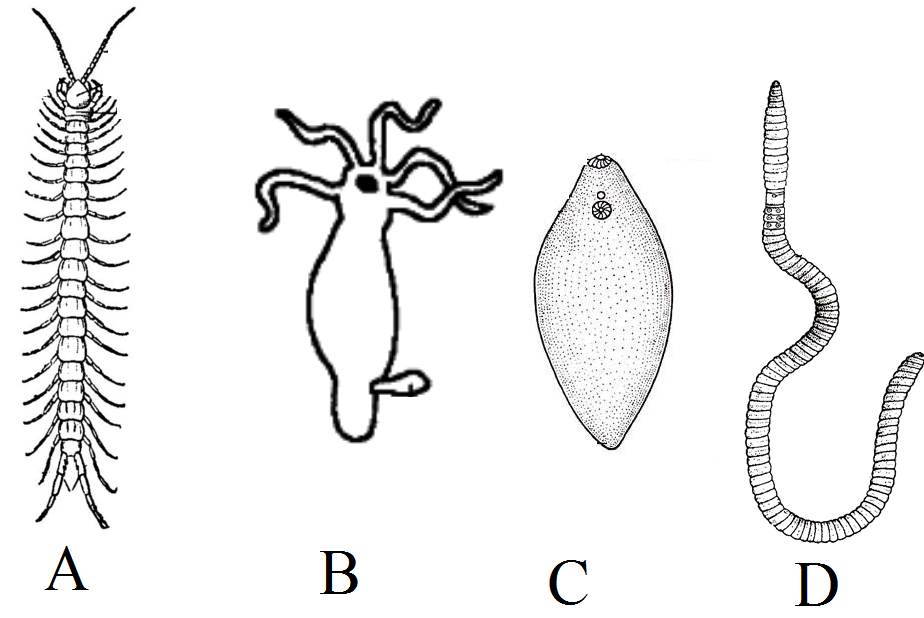
  1. Identify figure A to D.
  2. Which one of them is (i) diplobalstic; (ii) Coelomate?
  3. Which triplobalstic animal is (i) Acoelomate; (ii) Coelomate?
  4. Which one belong to phylum (i) Cnidaria; (ii) Platyhelminthes; (iii) Annelids; (iv) Arthropoda?
  5. Which one of them has (i) Organ level organization? (ii) Organ system level organization?
  6. Which one of them has excretory organs in the form of (i) Flame cells; (ii) Nephridia?
  7. Which one of them has trachea as the respiratory organ?