Question
Write IUPAC names of the following compound: $\text{CH}_3(\text{CH}_2)_4\text{CH}(\text{CH}_2)_3\text{CH}_3\\\ \ \ \ \ \ \ \ \ \ \ \ \ \ \ \ \ \ \ \ \ |\\\ \ \ \ \ \ \ \ \ \ \ \ \ \ \ \ \ \ \ \text{CH}_2-\text{CH}(\text{CH}_3)_2$
Answer


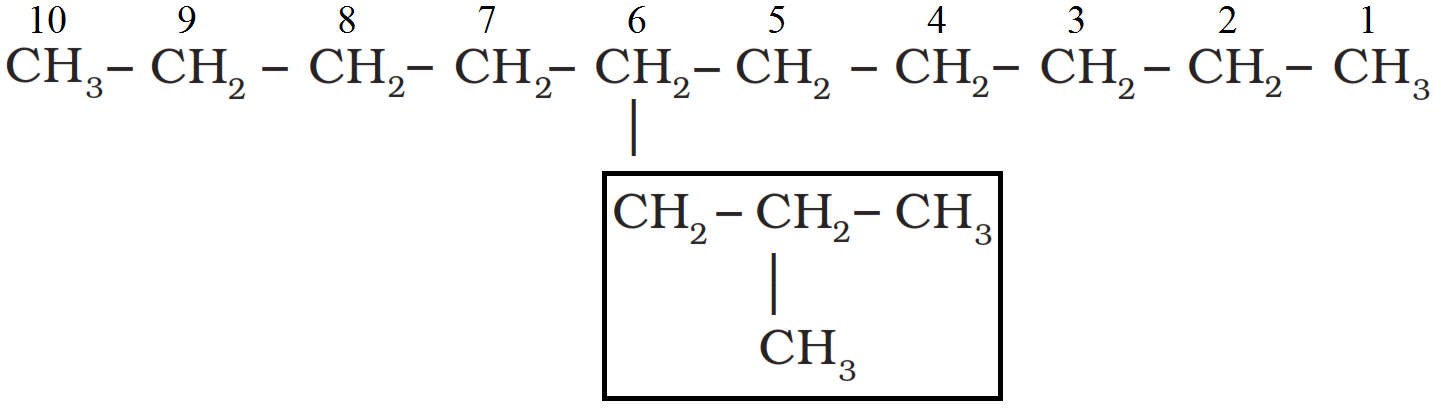
$\text{CH}_3(\text{CH}_2)_4\text{CH}(\text{CH}_2)_3\text{CH}_3\\\ \ \ \ \ \ \ \ \ \ \ \ \ \ \ \ \ \ \ \ \ |\\\ \ \ \ \ \ \ \ \ \ \ \ \ \ \ \ \ \ \ \text{CH}_2-\text{CH}(\text{CH}_3)_2$ can be written as:

IUPAC name: 5-(2-Methtlpropyl)-decane.

Need a full question paper?

Generate a complete, print-ready paper with questions like this in minutes — across 16+ boards, with answer keys.

Start Generating Free

Similar questions

What is light soda ash? Why is it called so?
Expansion of a gas in vacuum is called free expansion. Calculate the work done and the change in internal energy when 1litre of ideal gas expands isothermally into vacuum until its total volume is 5litre?
Give suitable reasons for the following:
i. $\left[\mathrm{SiF}_6\right]^{2-}$ is known whereas $\left[\mathrm{SiCl}_6\right]^{2-}$ not.
ii. Diamond is covalent, yet it has high melting point.
Comment on the spontaneity of a reaction at constant temperature and pressure in the following cases:
  1. $\Delta\text{H}<0\text{ and }\Delta\text{S}>0$
  2. $\Delta\text{H}>0\text{ and }\Delta\text{S}<0$
  3. $\Delta\text{H}<0\text{ and }\Delta\text{S}<0$
  4. $\Delta\text{H}>0\text{ and }\Delta\text{S}>0$
Why does $\mathrm{BeCl}_2$ react with water to give acidic solution? Give chemical reaction.
$N _2$ have bond order 3 and it is diamagnetic. Explain this on basis of MOT.
The aqueous solution of sugar does not conduct electricity. However, when sodium chloride is added to water, it conducts electricity. How will you explain this statement on the basis of ionisation and how is it affected by concentration of sodium chloride?
Is demineralised or distill water useful for drinking purposes? If not, how can it be made useful?
What mass of silver nitrate will react with 5.85g of sodium chloride to produce 14.35g of silver chloride and 8.5g of sodium nitrate, if the law of conservation of mass is true?
In any reversible reaction what is the effect of pressure on it?