Question
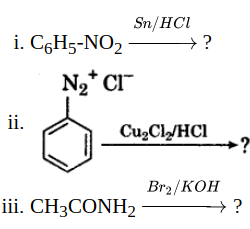
Write major product(s) in the following reaction .
Image

Answer

Get the step-by-step solution for this question inside the Vidyadip app.

Get the answer in the app

Need a full question paper?

Generate a complete, print-ready paper with questions like this in minutes — across 16+ boards, with answer keys.

Start Generating Free

Similar questions

Answer the following questions:
Give reasons:
  1. d-block elements exhibit more oxidation states than f-block elements.
  2. Orange solution of potassium dichromate turns yellow on adding sodium hydroxide to it.
  3. Zirconium (Z = 40) and Hafnium (Z = 72) have almost similar atomic radii.
Explain fuel cell in detail and explain the shortcomings of power generation from thermal plants.
Attempt any five of the following:
(a) Name the enzyme which convert surcrose into glucose and fructose.
(b) i. Name any two bases which are common to both DNA and RNA.
     ii. Which vitamin deficiency causes:
1. Bone deformities in children?
2. Pernicious anaemia?
(c) What are heterocyclic bases?
(d) Write the name of linkage joining two monosaccharides.
(e) Name the purines present in DNA.
(f) Give an example of fibrous protein.
(g) Of the two bases named below, which one is present in RNA and which one is present in DNA?
i. Thymine
ii. Uracil
Magnetic properties of coordination compounds. Explain in detail.
Match the items of Column I and Column II on the basis of data given below:
$\text{E}^{\ominus}_{\text{F}_2/\text{F}^-}=2.87\text{V},\text{ E}^{\ominus}_{\text{Li}^+/\text{Li}}=-3.5\text{V},\text {E}^{\ominus}_{\text{Au}^{3+}/\text{Au}}=1.4\text{V},\text{ E}^{\ominus}_{ \text{Br}_2/\text{Br}^-}=1.09\text{V}$
 
Column I
 
Column II
i.
$F_2$
a.
Metal is the strongest reducing agent.
ii.
$Li$
b.
Metal ion which is the weakest oxidising agent.
iii.
$Au^{3+}$​​​​​​​
c.
Non metal which is the best oxidising agent.
iv.
$Br^-$​​​​​​​
d.
Unreactive metal.
v.
$Au$
e.
Anion that can be oxidised by $Au^{3+}​​​​​​​$​​​​​​​
vi.
$Li^+$
f.
Anion which is the weakest reducing agent.
vii.
$F^-$
g.
Metal ion which is an oxidising agent.
The decomposition of a hydrocarbon follows the equation.$\text{k}=(4.5\times10^{11}\text{s}^{-1})\text{e}^{-28000}\text{ K/T}$
Calculate Ea.
Answer the following question:
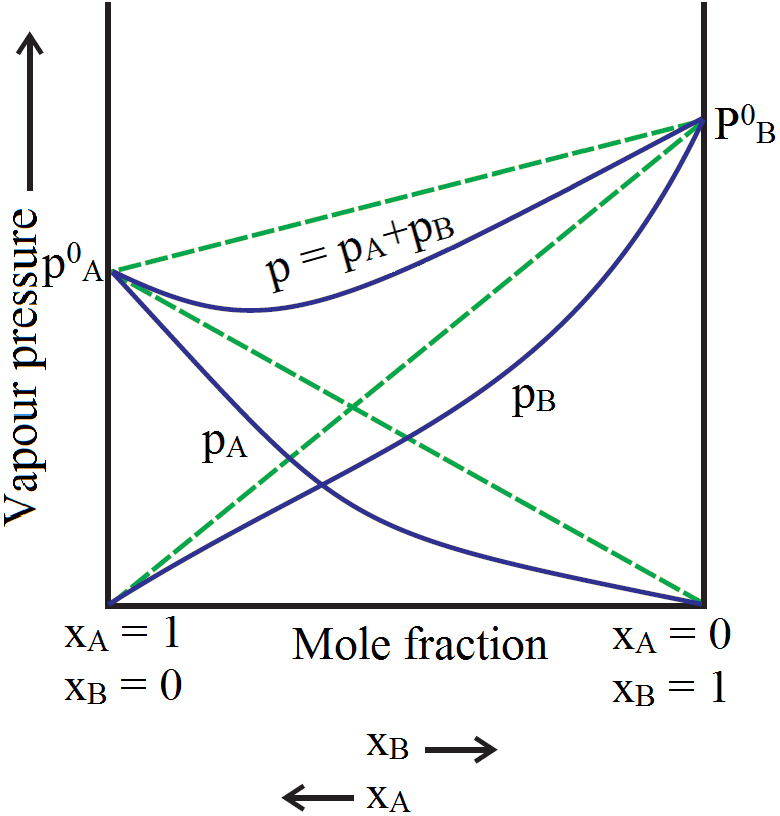
The graphical representation of vapour pressures of two component system as a function of composition is given alongside. By graphic inspection, answer the following questions:
  1. Are the A-B interactions weaker, stronger or of the same magnitude as A-A and B-B?
  2. Name the type of deviation shown by this system from Raoult’s law.
  3. Predict the sign of $\Delta_\text{mix}\text{H}$ for this system.
  4. Predict the sign of $\Delta_\text{mix}\text{H}$ for this system.
  5. Give an example of such a system.
  6. What type of azeotrope will this system form, if possible?
Match the properties given in Column I with the metals given in Column II.
 
Column I (Property)
 
Column II (Metal)
$(i)$
Element with highest second ionisation enthalpy
$(a)$
$Co$
$(ii)$
Element with highest third ionisation enthalpy
$(b)$
$Cr$
$(iii)$
$M$ in $M$ $(CO)6$ is
$(c)$
$Cu$
$(iv)$
Element with highest heat of atomisation
$(d)$
$Zn$
   
$(e)$
$Ni$
What is a semiconductor? Describe the two main types of semiconductors and contrast their conduction mechanism.
Explain the oxidation of primary, secondary and tertiary alcohols.