Question
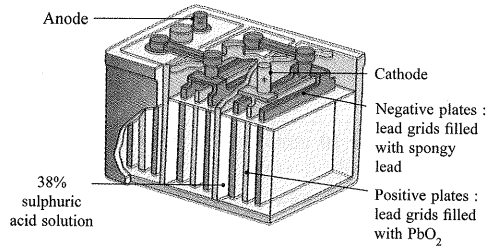
Write note on lead storage cell.

Need a full question paper?

Generate a complete, print-ready paper with questions like this in minutes — across 16+ boards, with answer keys.

Start Generating Free

Similar questions

Explain aldol condensation with suitable example. ### Write a short note: Aldol condensation.
A reaction is first order in A and second order in B.
  1. Write the differential rate equation.
  2. How is the rate affected on increasing the concentration of B three times?
  3. How is the rate affected when the concentrations of both A and B are doubled?
Explain the effect of hydrogen bond on boiling point of alcohol and phenol.
Write the Nernst equation and emf of the following cells at 298 K:
Pt(s) | Br2(l) | Br (0.010 M) || H+ (0.030 M) | H2(g) (1 bar)|Pt(s).
Write the structures of compounds A, B and C in the following reactions:
  1. $\text{CH}_3-\text{COOH}\xrightarrow{\text{ }\text{ }\text{ }\text{NH}_3/\triangle\text{ }\text{ }\text{ }}\text{A}\xrightarrow{\text{ }\text{ }\text{ }\text{Br}_2/\text{KOH(aq)}\text{ }\text{ }\text{ }}\text{B}\xrightarrow{\text{ }\text{ }\text{ }\text{CHCL}_3+\text{alc.KOH}\text{ }\text{ }\text{ }}\text{C}$
  1. $\text{C}_6\text{H}_5\text{N}_2^+\text{BF}_4^-\xrightarrow[\triangle]{\text{NaNO}_2/\text{Cu}\text{ }\text{ }}\text{A}\xrightarrow{\text{ }\text{ }\text{ }\text{Fe}/\text{HCL}\text{ }\text{ }\text{ }}\text{B}\xrightarrow{\text{ }\text{ }\text{ }\text{CH}_3\text{COCL}/pyridine\text{ }\text{ }\text{ }}\text{C}$
A + 2B → 3C + 2D. The rate of disappearance of B is 1 × 10⁻² mol L-1 s -1. What will be:
  1. Rate of the reaction.
  2. Rate of change in concentration of A and C?
Calculate the standard cell potential of the galvanic cell in which the following reaction takes place:

$\text{2 Cr(s)}+3\text{ Cd}^{2+}\text{(aq.)}\rightarrow2\text{Cr}^{3+}\text{(aq.)}+3\text{ Cd(s)}$

Also calculate the $\Delta_{\text{r}}\text{G}^{\ominus}$ value of the reaction.

$(\text{Given: }\text{E}^{\ominus}_{\text{ }\text{ }\text{ }\text{ Cr}^{3+/}/\text{Cr}}=+0.74\text{V};\text{E}^{\ominus}_{\text{ }\text{ }\text{ }\text{ }\text{Cd}^{2+}\text{/Cd}}=-0.40\text{V and F = 96500 C mol}^{-1})$.
Complete the following chemical equations:
  1. $\text{MnO}_{4}^{-}+\text{C}_{2}\text{O}_{4}^{2-}+\text{H}+\rightarrow$
  2. $\text{KMnO}_{4}\xrightarrow{\text{heated}}$
  3. $\text{Cr}_{2}\text{O}_{4}^{2-}+\text{H}_{2}\text{S}+\text{H}^{+}+\rightarrow$
Zinc rod is dipped in 0.1 M solution of $ZnSO _4$
The salt is $95 \%$ dissociated at is dilution at 298 K . Calculate the electrode potential. Given
$E ^0\left( Zn ^{2+} / Zn \right)=-0.76$
What happens when:
(i) Chlorine gas reacts with NaOH solution.
(ii) Nitric acid reacts with Zn or Cu in different concentrations.