Question
Write Short note: Monozygotic twins.

Answer

The twins developed from a single embryo are called monozygotic twins. If within 8 days of zygote formation i.e. in early embryonic development cells of that embryo divide into two groups. Each one develop as two separate embryos forming two monozygotic twins. Monozygotic twins are genetically exactly similar to each other. The gender of the twins is also same.

The Siamese twins develop from monozygotic twins, if the embryonic cells are divided into two groups 8 days after the zygote formation. These are conjoined twins where some parts of body are joined to each other. Also some organs are common in Siamese twins.

Need a full question paper?

Generate a complete, print-ready paper with questions like this in minutes — across 16+ boards, with answer keys.
Start Generating Free

Similar questions

Write short note:  Mock drill.
What is the stimulus in:
  1. Phototropism?
  2. Geotropism?
  3. Chemotropism?
  4. Hydrotropism?
  5. Thigmotropism?
The pancreas is made up of two parts A and B. The part A secretes insulin whereas part B secretes pancreatic juice.
  1. Which part is functioning as an endocrine gland? Why?
  2. What is insulin and what effect does it have in the body?
  3. Name the disease which can be treated by giving insulin injection.
  4. What does pancreatic juice contain? Where does pancreatic juice go?
  5. Name the life process in which pancreatic juice is made use of.
A potted plant is growing in a transparent glass jar. In this plant, X and Y are the two growing parts having a lot of meristematic tissue. It is observed that the part X of this plant exhibits positive geotropism but negative phototropism. On the other hand, part Y of this plant exhibits negative geotropism but positive phototropism.
  1. Name the part X of plant.
  2. Name the part Y of plant.
  3. Which part of the plant, X or Y, will exhibit positive hydrotropism?
  4. Which part of the plant, X or Y, can have tendrils on it?
  5. Which phytohormone causes the part X to exhibit negative phototropism?
Describe the structure of diamond. Draw a simple diagram to show the arrangement of carbon atoms in diamond.
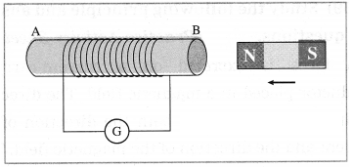
Take a coil AB having 10-15 turns. Connect the two ends of the coil to the galvanometer as shown in Figure. Take a strong bar magnet. (1) Move the north pole of the magnet towards the end B of the coil.
Image

Observe the deflection of the pointer in the galvanometer. Note the direction of the deflection (i.e. right or left). (2) Now repeat this with the south pole of the magnet towards the end B of the coil. Again observe the deflection. Note its direction. (3) What will happen if instead of the magnet, the coil is moved? (4) If both the coil and the magnet are kept stationary, do you observe any deflection? (5) Compare the direction of the deflection when the north pole of the magnet is moved towards the end B of the coil with that when the end B of the coil is moved away from the north pole of the magnet. (6) What conclusions do you draw from the observations?

A small part of the shoot of a plant is removed with a sharp knife. When the lower end of this small part of the shoot is buried in moist soil, it gradually develops roots and shoots and grows to become a new plant.
  1. What is the name of this method of propagating plants?
  2. What care should be taken while removing a small part of the shoot from the parent plant with a knife?
  3. Name any two plants which provide us with food directly or indirectly and are grown by this method.
  4. Give one advantage of this method of producing new plants.
  5. State whether it is a sexual method of reproduction or an asexual method. Why?
  6. What special name can be given to the genetically identical new plants produced by this technique?
An object is placed 15cm from (a) a converging mirror, and (b) a diverging mirror, of radius of curvature 20cm. Calculate the image position and magnification in each case.
When hydrogen is passed over copper oxide, copper and steam are formed. Write a balanced equation for this reaction and state which of the chemicals are:
  1. Elements.
  2. Compounds.
  3. Reactants.
  4. Products.
  5. Metals.
  6. Non-metals.