Question
Write short note: Pre-disaster management.

Answer

The management measures taken before onset of a disaster is called pre-disaster management.
In pre-disaster management, complete preparation and planning to face any type of disaster is done. For this purpose, following steps are taken.
  • Identifying the areas where the disaster can strike. Such disaster-prone areas are to be thoroughly studied.
  • Through predictive intensity maps and hazard maps, the information is collected about the intensity of disaster and probable sites of disasters respectively.
  • Special training for disaster management is given to the concerned people.
  • The mass awareness is created about disaster management through training programmes, mass media and internet, etc.

Need a full question paper?

Generate a complete, print-ready paper with questions like this in minutes — across 16+ boards, with answer keys.
Start Generating Free

Similar questions

A metal $X$ which is resistant to corrosion is produced by the electrolysis of its molten oxide whereas another metal $Y$ which is also resistant to corrosion is produced by the reduction of its oxide with carbon. Metal $X$ can be used in powder form in thermite welding whereas metal $Y$ is used in making cathodes of ordinary dry cells.
  1. Name the metals $X$ and $Y.$
  2. Which of the two metals is more reactive : $X$ or $Y?$
  3. Name one ore or metal $X$. Also write its chemical formula.
  4. Name one ore of metal $Y.$ Also write its chemical formula.
  5. Name one alloy of metal $X$ and one alloy of metal $Y.$
What are the various alloys used in daily life? Where are those used?
How do we decide that a given material is a good conductor of electricity or is an insulator?
Name the scientist who gave the theory of origin of life on earth. What is this theory?
Describe the working of human blood circulatory system with the help of a suitable diagram which shows all the steps involved.
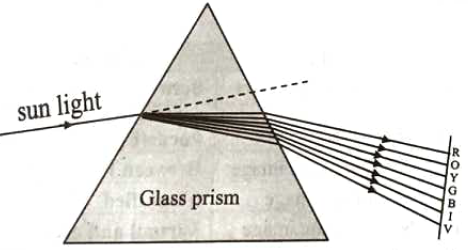
Observe the given diagram and answer the questions :
Image
i. Name the process shown in the figure.
II. Name the colour that deviates the most.
iii. Name the colour that deviates the least.
iv. Name any one phenomenon in the nature which is based on the above process.
v. Define 'spectrum'.
Prepare a concept map for the solar thermal power station
When an insect sits on the flower of a plant then some particles A present in the top of little stalks in the flower attach to its body hair. When this insect now sits on the flower of another similar plant, then particles A attached to the hair of insect are put on the top of a flask-shaped organ at the centre of flower. The particle A grows a long tube b from the top of flask-shaped organ through which C moves down and reaches the bottom part of flask-shaped organ. Here C fuses with the nucleus of d contained in structure E. the fusion of C and D forms a new cell f which grows and develops into a seed of the plant.
  1. What are particles A? What is the process of transferring A from one flower to another flower of similar plant by the insect known as?
  2. What is the name of tube B?
  3. What is C which moves down through the tube B?
  4. Name D and E.
  5. What is F?
How is nuclear fission reaction carried out in nuclear power plants?
The organisms A, B and C can obtain their food in three different ways. Organism A derives its food from the body of another living organism which is called its D, without killing it. The organism B takes in the solid food by the process of ingestion, digests a part of this food and throws out undigested food in the process called E. The organism C obtains its food from dead and decaying plants.
  1. What is the mode of nutrition of (i) organism A (ii) organism B, and (iii) organism C?
  2. What is the organism like D called?
  3. Name the process E.
  4. Give one example each of organisms like A, B and C.
  5. What is the general name of three modes of nutrition exhibited by organisms A, B and C?