Question
Write short note :
Structure of the Modern Periodic table.

Answer

(i) The Modern Periodic table contains seven horizontal rows called the periods 1 to 7.
(ii) Similarly, the eighteen vertical columns are the groups 1 to 18.
(iii) The arrangement of the periods and groups results into formation of boxes.
(iv) Atomic numbers are serially indicated in the upper part of these boxes.
(v) Each box corresponds to the place for one element.
(vi) Apart from these seven rows, two rows are shown separately at the bottom of the periodic table.
(vii) These are called Lanthanide series and Actinide series respectively.
(viii) There are 118 boxes in the periodic table including the two series.
(ix) It means that there are 118 places for elements in the Modern Periodic table.
(x) The Modern Periodic table is now completely filled means all the 118 elements are now discovered.
(xi) The entire periodic table is divided into four blocks, viz, s-block, p-block, d-block and f-block.
(xii) The s-block contains the groups 1 and 2 elements.
(xiii) The groups 13 to 18 constitute the p-block elements.
(xiv) The groups 3 to 12 constitute the d-block elements. The d-block elements are called transition elements.
(xv) The lanthanide and actinide series at the bottom form the f-block elements.
(xvi) A zig-zag line can be drawn in the p-block of the periodic table.
(xvii) The metalloid elements lie along the border of this zig-zag line.
(xviii) All the metals lie on the left side of the zig-zag line, while all the non-metals lie on the right side.

Need a full question paper?

Generate a complete, print-ready paper with questions like this in minutes — across 16+ boards, with answer keys.

Start Generating Free

Similar questions

Mock Drill is useful.
Write short note: Germinal layers.
What is a plant hormone? Name four plant hormones. State one function of each.
What is the reaction called when oxidation and reduction take place simultaneously? Explain with one example.
There are four tiny organisms A, B, C and D. The organism A is a parasitic protozoan which causes a disease known as kala-azar. The organism B is a microscopic single-celled animal which causes malaria disease in human beings. The organism C is a unicellular animal which can change its body shape according to need, it has no fixed shape. The organism D is also a unicellular animal which is slipper-shaped having a large number of tiny hair all around its body.
  1. Name the organisms A, B, C and D.
  2. Name one characteristic body feature of organism A.
  3. Name the insect which carries organism B and transmits it from one person to another.
  4. What name is given to the asexual method of reproduction of (i) organism A, and (ii) organism B?
  5. Where do organisms C and D live?
What is biodiversity? Write any four steps to conserve biodiversity.
A red-brown metal $X$ forms a salt $XSO_4$. When hydrogen sulphide gas is passed through an aqueous solution of $XSO_4,$ then a black precipitate of $XS$ is formed alongwith sulphuric acid solution.
  1. What could the salt $XSO_4$ be?
  2. What is the colour of salt $XSO_4?$
  3. Name the black precipitate $XS.$
  4. By using the formula of the salt obtained in $(a)$ above, write an equation of the reaction which takes place when hydrogen sulphide gas is passed through its aqueous solution.
  5. What type of chemical reaction takes place in this case?
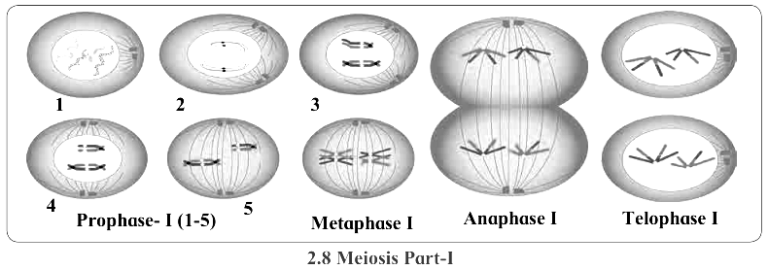
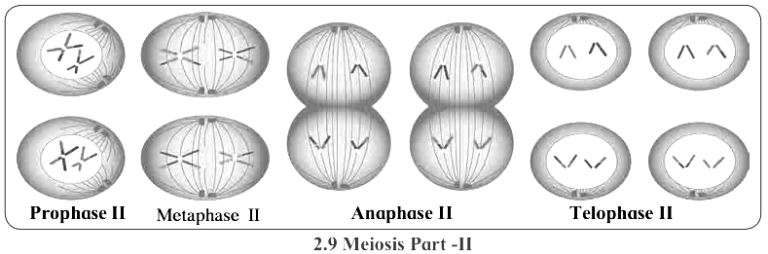
Observe the diagrams and answer the following questions.
Image
Image

(a) Which peculiarity do you observe in the figure of Metaphase-I of meiosis ?
(b) What is the important difference between Telophase-I and Telophase-II of meiosis?
(c) Which figure shows phenomena of crossing over?
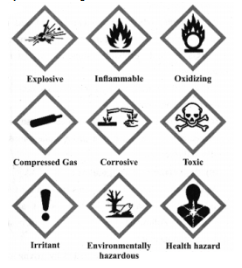
Some symbols are given below. Explain those symbols. Which disasters may occur if those symbols are ignored?
Image
Renewable energy is, energy produced from sources that do not deplete or can be replenished within a human’s life time. The most common examples include wind, solar, geothermal, biorhass, and hydroelectric power. This is in contrast to non-renewable sources such as fossil fuels. Most renewable energy is derived directly or indirectly from the sun. Sunlight can be captured directly using solar technologies. The sun’s heat drives winds, whose energy is captured with turbines. Plants also rely on the sun to grow and their stored energy can be utilized for bioenergy. Not all renewable energy sources rely on the sun. For example, geothermal energy utilizes the Earth’s internal heat, tidal energy relies on the gravitational pull of the moon, and hydroelectric power relies on the flow of water.
Questions and Answers :
(1) What is renewable energy?
(2) Give the examples of renewable energy.
(3) Why will energy from fossil fuel be over soon?
(4) Name the renewable sources of energy which are not dependent on sun. What are they dependent upon?
(5) Which type of energy do we mostly use in India?