Question
Write short notes :
Acetylation

Answer

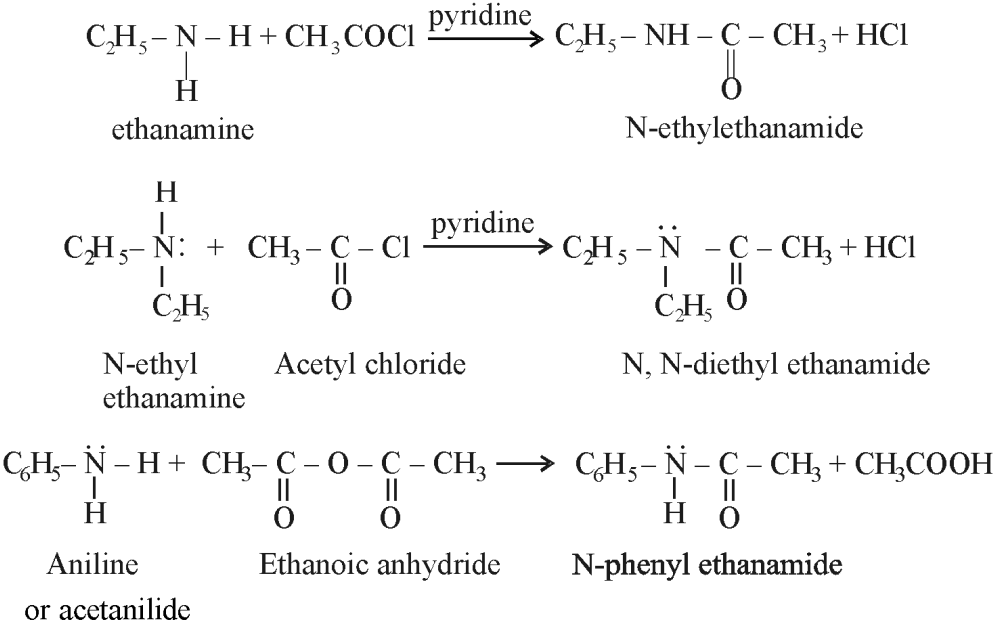
Acetylation : Aliphatic and aromatic primary and secondary amines react with acid chloride and acid anhydride by nucleophilic substitution reaction. This reaction is known as acylation.
This reaction is considered as the replacement of hydrogen atom of $- NH _2$ or $> N - H$ group by aelyl group. when $CH _3 COCl$ is taken in this reaction then it is called acetylation. This reaction is performed in presence of pyridine which are moves HCl so formed shifts equilibrium to the right hand side.
Image

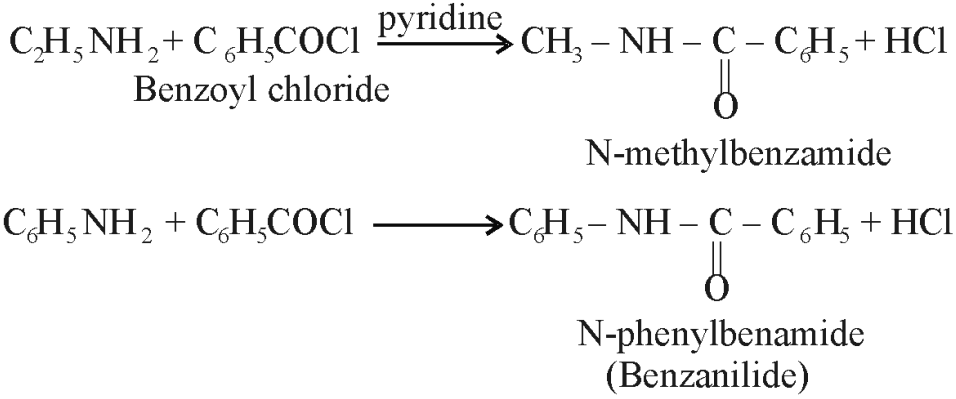
When amines are treated with benzoyl chloride then this reaction is called benzyoylation and on the basis of name of scientist this is called Schotten-Baumann reaction.
Image
Amines reacts wih carboxylic acids at room temperature forms salts.
Image

Need a full question paper?

Generate a complete, print-ready paper with questions like this in minutes — across 16+ boards, with answer keys.

Start Generating Free

Similar questions

Explain the structure of different disaccharides.
Write the rate law for a first order reaction. Justify the statement that half life for a first order reaction is independent of the initial concentration of the reactant.
A first order reaction takes 30 min for 50% completion, what would be time for its 90% completion.
Match the laws given in Column I with expresions given in Column II.
  Column I
  Column II
i. Raoult’s law
a. $\Delta\text{T}_\text{f}=\text{K}_\text{f}\text{m}$
ii. Henry’s law
b. $\pi=\text{CRT}$
iii. Elevation of boiling point
c. $\text{p}=\text{x}_1\text{p}^0_1+\text{x}_2\text{p}^0_2$
iv. Depression in freezing point
d. $\Delta\text{T}_\text{b}=\text{K}_\text{b}\text{m}$
v. Osmotic pressure
e. $\text{p}=\text{K}_\text{H}\cdot\text{x}$
(a) What is van't Hoff factor? Explain.
(b) Write the equation of molecular number properties including van't Hoff factor.
19.5 g of CH2FCOOH is dissolved in 500 g of water. The depression in the freezing point of water observed is 1.0°C. Calculate the van't Hoff factor and dissociation constant of fluoroacetic acid. [If $K_f=1.86 K kg mol ^{-1}$ and density of solution $\left.=1.124 g mL ^{-1}\right]$
A solution containing 30 g of non-volatile solute exactly in 90 g of water has a vapour pressure of 2.8 kPa at 298 K. Further, 18 g of water is then added to the solution and the new vapour pressure becomes 2.9 kPa at 298 K. Calculate :
(i) molar mass of the solute
(ii) vapour pressure of water at 298 K
Give the structures of $A, B$ and $C$ in the following reactions :
(i) $CH _3 CH _2 I \xrightarrow{ NaCN }$$A \frac{ OH ^{-}}{\text {partial hydrolysis }} \rightarrow B$$\xrightarrow{ NaOH + Br _2} C$
(ii) $C _6 H _5 Cl \xrightarrow{ CuCN } A \xrightarrow{ H _2 O / H ^{+}} B \xrightarrow{ NH _3} C$
(iii) $CH _3 CH _2 Br \xrightarrow{ KCN } A \xrightarrow{ LiAlH _4} B \frac{ HNO _2}{0^{\circ} C } \rightarrow C$
(iv) $C _6 H _5 NO _2 \xrightarrow{ Fe / HCl } A \xrightarrow{ NaNO _2+ HCl } B$ $\xrightarrow{ H _2 O / H ^{+}} C$
(v) $CH _3 COOH \frac{ NH _3}{ Heat } \rightarrow$ A $\xrightarrow{NaOBr} B$$\xrightarrow{ NaNO _2 / HCl } C$
(vi) $C _6 H _5 NO _2 \xrightarrow{ Fe / HCl }A \frac{ HNO _2}{273 K} \rightarrow$$B \xrightarrow{ C _6 H _5 OH } C$
How can you remove the hard calcium carbonate layer of the egg without damaging its semiprermiable membrane? Can this egg be inserted into a bottle with a narrow neck without distorting its shape? Explain the process involved.
Write the $S _{ N } 1$ mechanism of unimolecular nucleophilic substitution reaction.