Question
Write short notes: Functional group.
All organic compounds are derivatives of hydrocarbons. The derivatives are formed by replacing one or more H-atom/atoms of hydrocarbon by some other hetero atom or groups of atoms containing hetero atoms. After replacement, a new compound is formed which has properties different from the parent hydrocarbon.
Examples: For methane, if one hydrogen atom is replaced by an - $\mathrm{OH}$ group, then a compound is methyl alcohol $\left(\mathrm{CH}_3 \mathrm{OH}\right)$. The $-\mathrm{OH}$ group is known as the alcoholic functional group.
Functional group is organic compound:
1. Alcohol: - $\mathrm{OH}$ (hydroxy group)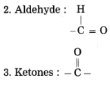
4. Carboxylic acid: $-\mathrm{COOH}$
Generate a complete, print-ready paper with questions like this in minutes — across 16+ boards, with answer keys.
| Element | K | N | Rb | Cs | Li |
| Atomic radius | 231 | 186 | 244 | 262 | 152 |