Question
Write short notes on following:
- Diploblastic and Triploblastic Organization.
- Different types of coelom.
- Segmentation.
- Notochord.
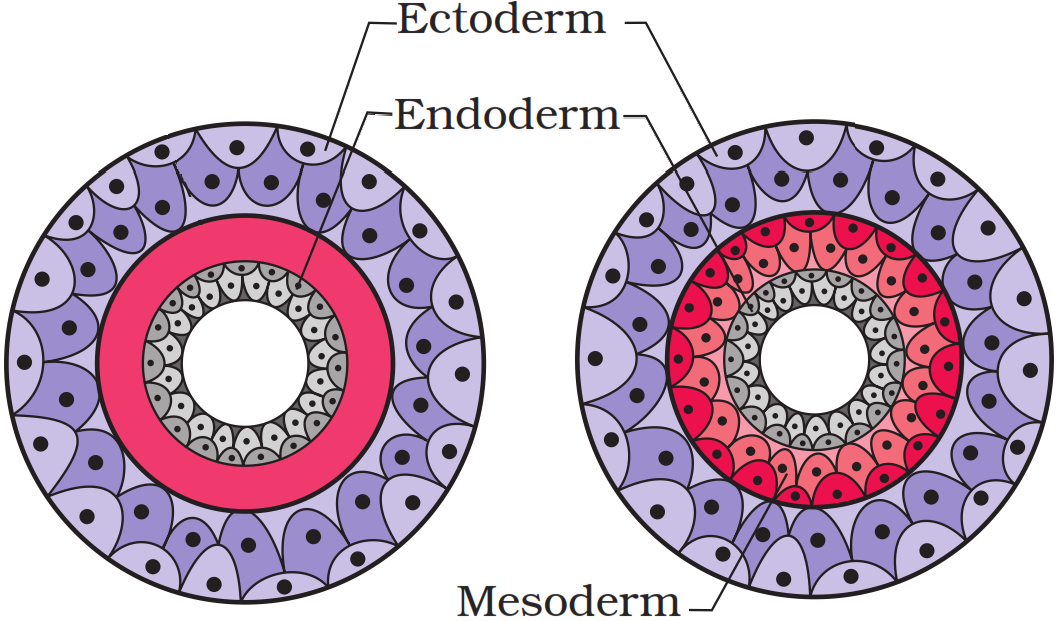
Diploblastic Organization: Animals in which the cells are arranged in two embryonic layers, an external ectoderm and an internal endoderm, are called diploblastic animals, e.g., coelenterates. An undifferentiated layer, mesoglea, is present in between the ectoderm and the endoderm.
Triploblastic Organization: Those animals in which the developing embryo has a third germinal layer, mesoderm, in between the ectoderm and endoderm, are called triploblastic animals. Example: platyhelminthes to chordates.
Presence or absence of a cavity between the body wall and the gut wall is very important in classification. The body cavity, which is lined by mesoderm is called coelom.
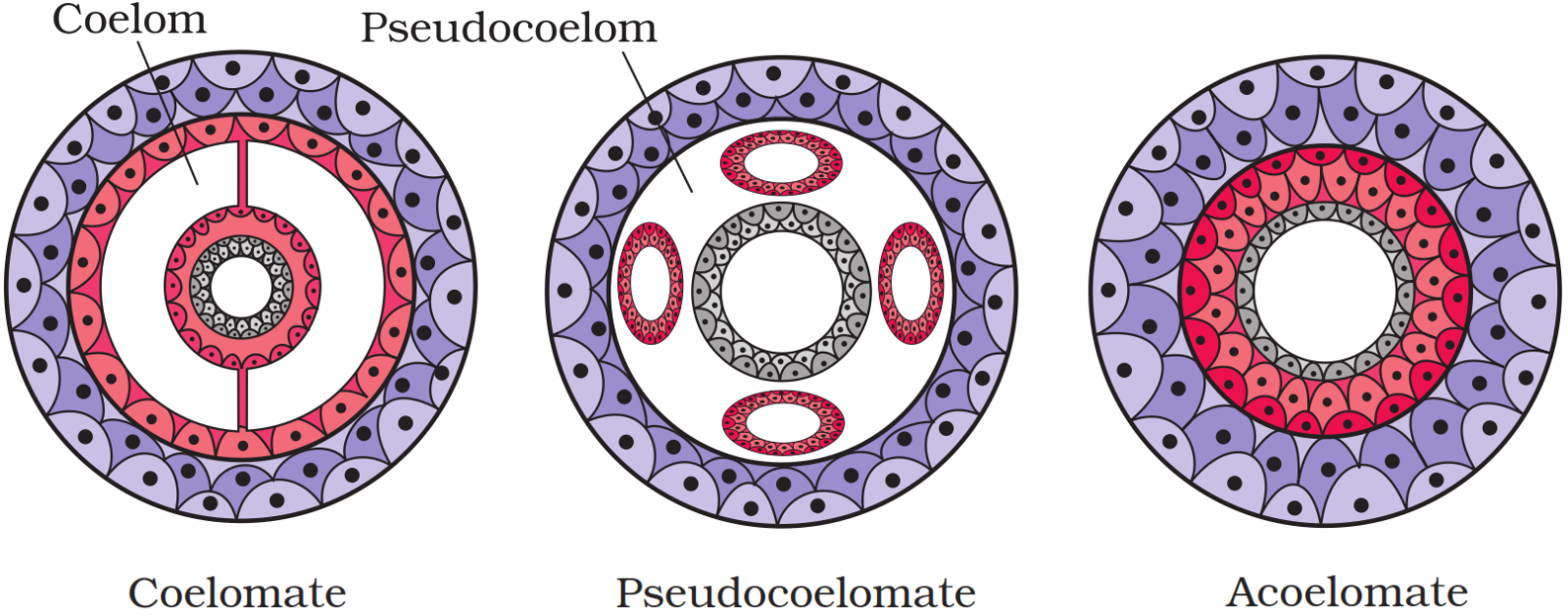
Coelomates: Animals possessing coelom are called coelomates, e.g., annelids, molluscs, arthropods, echinoderms, hemichordates and chordates.
Pseudocoelomates: In some animals, the body cavity is not lined by mesoderm, instead, the mesoderm is present as scattered pouches in between the ectoderm and endoderm. Such a body cavity is called pseudocoelom and the animals possessing them are called pseudocoelomates, e.g., aschelminthes.
Acoelomates: The animals in which the body cavity is absent are called acoelomates, e.g., platyhelminthes.
In some animals, the body is externally and internally divided into segments with a serial repetition of at least some organs. For example, in earthworm, the body shows this pattern called metameric segmentation and the phenomenon is known as metamerism.
Notochord is a mesodermally derived rod-like structure formed on the dorsal side during embryonic development in some animals. Animals with notochord are called chordates and those animals which do not form this structure are called non-chordates, e.g., porifera to echinoderms.
Generate a complete, print-ready paper with questions like this in minutes — across 16+ boards, with answer keys.