Question
Write short notes on: Leaching method

Answer

Leaching: Leaching is the first step in the extraction of the metals like aluminium, gold and silver from their ores. In this method the ore is soaked in a particular solution for long time. The ore dissolves in that solution due to specific chemical reaction. The gangue, however, does not react and therefore does not dissolve in that solution. It can be separated easily.
For example, concentration of bauxite, the aluminium ore, is done by leaching method. Bauxite is soaked in aqueous $NaOH$ or aqueous $Na _2 CO _3$ which dissolves the main ingredient alumina in it. This means that bauxite is leached by sodium hydroxide.

Need a full question paper?

Generate a complete, print-ready paper with questions like this in minutes — across 16+ boards, with answer keys.
Start Generating Free

Similar questions

Describe the process of nutrition in Draw labelled diagrams to show the various steps in the nutrition in Amoeba.
Write the chemical formula of ammonium chloride. Explain why an aqueous solution of ammonium chloride is acidic in nature$?$ Illustrate your answer with the help of a chemical equation.
The top part A of the flask-shaped reproductive organ X in the flower of a plant secrets a surgery substance into its lower part B which goes towards the bottom part C of the flask-shaped organ. When a tiny grain D coming from the top part E of another reproductive organ Y i the flower falls on part A, it grows a long tube F through the organ X i response to the sugary substance and reaches the bottom part C of flask-shaped organ to carry out fertilisation.
  1. Name parts (i) organ X, and (ii) organ Y, inside the flower?
  2. Name parts (i) A (ii) B, and (iii) C, of flask-shaped organ.
  3. Name (i) grain D, and (ii) part E of organ Y.
  4. Name the tube F.
  5. What is the phenomenon of growing a long tube in response to sugary substance in the process of fertilisation in a flower known as?
If the distance between two bodies is increased by a factor of $5$, (i) by what factor will the gravitational force change if the masses are kept constant? (ii) by what factor will the mass of one of them have to be altered, keeping the other mass the same, to maintain the same gravitational force between the two bodies?
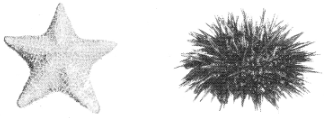
Observe the figure and answer the following questions.
Image
(a) To which phylum these organisms belong?
(b) Name the substance with which their body is covered.
(c) Name their organs of locomotion.
(a) Draw a neat labelled diagram of human eye.
(b) What is the minimum distance of distinct vision for a normal human eye ?
(c) Name the capacity of the eye lens to change its focal length as per need.
(d) Name the defect of eye vision in which the focussing power of eye lens decreases with age.
What is a plant hormone? Name four plant hormones. State one function of each.
There are four organisms A, B, C and D. The organism A eats only the flesh of other animals as food. The organism B can eat grains, fruits and vegetables as well as meat and fish. The organism C can make the food itself from simple inorganic substances present in the environment by utilising sunlight energy. On the other hand, organism D eats only plants and their products as food.
  1. Which organism is
  1. Omnivore,
  2. Herbivore,
  3. Carnivore?
  1. Which organism is an autotroph?
  2. Which organism is/ are heterotroph (s)?
  3. Which organism can be a producer?
  4. Which organism is/ are consumer (s)?
Give one example each of organisms which could be like A, B, C and D.
Depending upon above information, explain the various effects of the disaster of railway accident.
How does a biodegradable waste differ from a non-biodegradable waste? Give two examples of non- biodegradable wastes which pollute our environment.