Question
Write short notes on: Magnetic separation method

Answer

Magnetic separation method: Electro-magnetic machine is used in this method. The main parts of this machine are two types of iron rollers and the conveyor belt continuously moving around them. One of the rollers is nonmagnetic while the other is electromagnetic. The conveyor belt moving around the rollers is made up of leather or brass (nonmagnetic). The powdered ore is poured at that end of the conveyor belt which is on the side of the nonmagnetic roller. Two collector vessels are placed below the magnetic roller.

The particles of the nonmagnetic part in the ore are not attracted towards the magnetic roller. Therefore, they are carried out further along the belt and fall in the collector vessel which is away from the magnetic roller. Simultaneously the particles of the magnetic ingredients of the ore stick to the magnetic roller and therefore fall in the collector vessel near the belt.Image
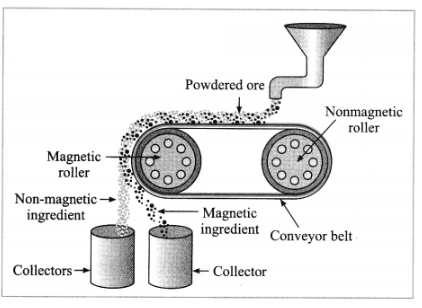
In this way the magnetic and nonmagnetic particles in the ore are separated because of their magnetic nature. For example, cassiterite is a tin ore. It contains mainly the nonmagnetic ingredient stannic oxide $\left( SnO _2\right)$ and the magnetic ingredient ferrous tungstate $\left( FeWO _4\right)$. These are separated by the electromagnetic method.

Need a full question paper?

Generate a complete, print-ready paper with questions like this in minutes — across 16+ boards, with answer keys.

Start Generating Free

Similar questions

Suggest some measures at individual level, a person can follow to protect the environment
There are three plants A, B and C. The flowers of plant A open their petals in bright light during the day but close them when it gets dark at night. On the other hand, the flowers of plant B open their petals at night but close them during the day when there is bright light. The leaves of plant C fold up and droop when touched with fingers or any other solid object.
  1. Name the phenomenon shown by the flowers of (i) plant A, and (ii) plant B.
  2. Name one flower each which behaves like the flower of (i) plant A, and (ii) plant B.
  3. Name the phenomenon exhibited by the leaves of plant C.
  4. Name a plant whose leaves behave like those of plant C.
  5. Which plant/ plants exhibit the phenomenon based on growth movements?
Write short notes: Biodiversity.
Explain with an example, how genes control the characteristics (or traits).
The molecular formula of sulphur is $S_8$ in which eight sulphur atoms are bonded to each other to form a ring. Draw an electron $-$ dot structure of $S_8$ without showing cirlces.
what is the periodic trend in the variation of valency while going from left to right within a period? Explain your answer with reference to period 2 and period 3.
Classify the following into herbivores, carnivores and omnivores:
Lion, Man, Dog, Goat, Crow, Elephant, Snake, Hawk, Rabbit, Deer.
When a human female reaches a certain age then vaginal bleeding occurs for a few days after regular time intervals.
  1. What is this process known as (i) in scientific terms, and (ii) in everyday language?
  2. At what approximate age this process starts in human females? When is the human female said to have attained at this stage?
  3. After how much time is this process repeated? For how many days does this process usually last?
  4. What does the onset of this process in human females signify?
  5. At which particular event in the life of a human female does this process stop temporarily but start again?
  6. At which approximate age of human female does this process stop permanently?
Taking into consideration the period of the elements given below, answer the following questions:
ElementAtomic radius (pm)
O66
B88
C77
N74
Be111
Li152
i. Arrange the above elements in a decreasing order of their atomic radii.
ii. State the period to which the above elements belong.
iii. Why this arrangement of elements is similar to the above period of the modern periodic table?
iv. Which of the above elements have the biggest and the smallest atom?
v. What is the periodic trend observed in the variation of atomic radius while going from left to right within a period?
Draw a neat labelled diagram to show the magnetic effect of electric current.