Question
Write short notes on the following.
  1. Skull.
  2. Chest bones.
  3. Backbone.
  4. Hip bone.
  5. The shoulder bone.
  6. Limb bone.

Answer

  1. The skull: The skull has two main parts. They are the cranium (cra-ni-um) or the brain case and the facial bones. The bones of the cranium are flat. They are held firmly like a zipper. The cranium covers and protects the brain. The facial bones comprise of the upper and lower jaws and a few other bones. The lower jaw is movable. The movement of the lower jaw enables us to eat, talk, and sing. The skull also includes a pair of eye sockets. These form a safe pocket for the eyes.
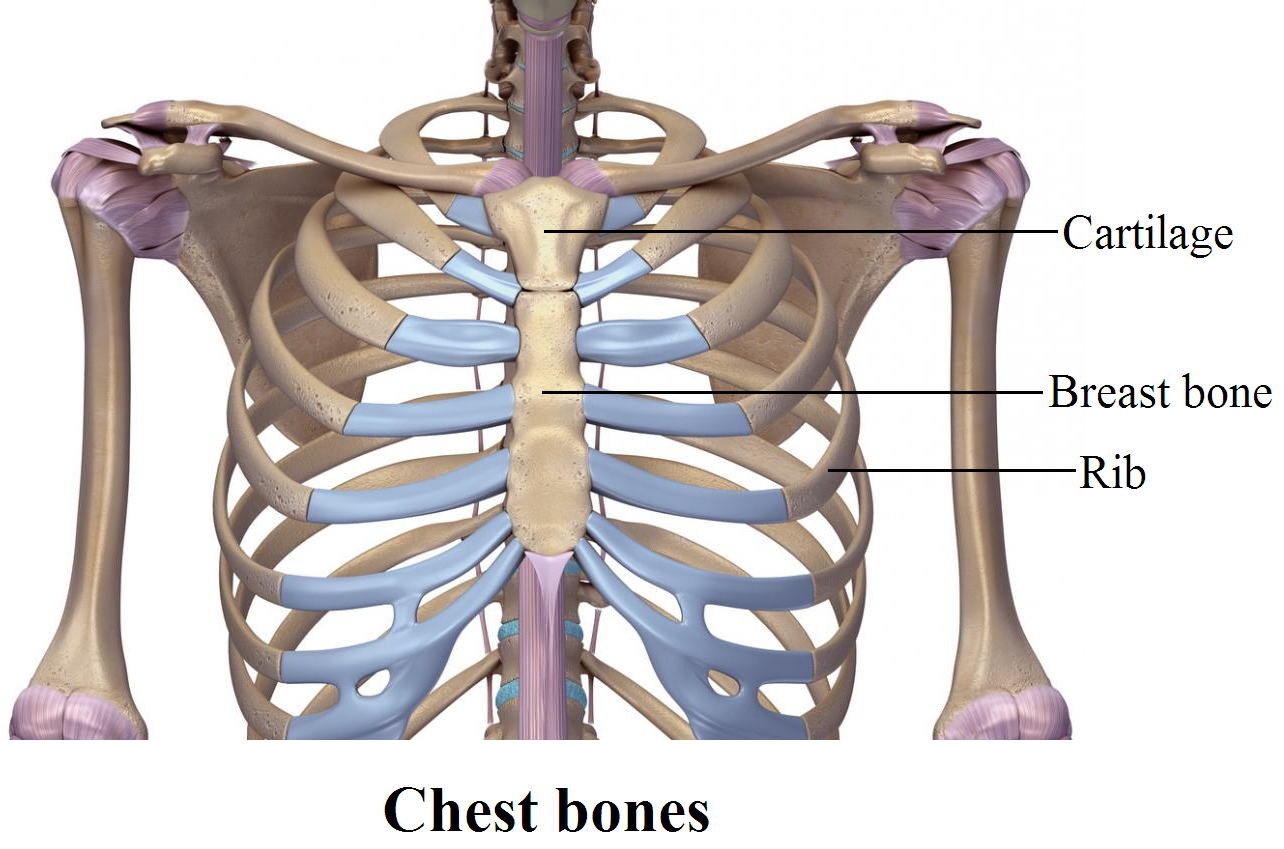
  2. The chest bones: The chest is a cone-shaped cage. It encloses the heart and the lungs. At the back are the vertebrae, 12 pairs of ribs curve surround the sides. Ribs are attached to the sides of each vertebrate. Ten of them are also attached by cartilage to the breast bone at the front. Two ribs are free. These are called floating ribs.

The ribs are joined in such a way that they allow the necessary movement of the chest during breathing.
  1. Backbone: Vertebral column or backbone is composed of 33 small, ring-like vertebrae joined end to end. Thus it forms a hollow bony tube. The main nerve cord passes through it. The backbone has five regions from top to bottom, they are the neck, chest, belly, hip and tail. Five vertebrae of the hip and four vertebrae of tail are fused to form 1 bone [turn 26 bones of vertebrae in an adult.
  2. Hip bone: The hip bone is formed by the fusion of three bones. The hip bones together with the last two parts of the backbone form a large bony bowl. It is called the pelvis (pel-vis). It is the lowest and strongest part on which we sit on. The thigh bones are attached to the hip bones.
  3. Shoulder bones: The shoulder bone is formed by the collar bone and the shoulder blades. It connects the upper part of the chest and the bones of the hand. The bones of the upper arm attach with the shoulder bones.
  4. Limb bones: The hand comprises of the upper arm, fore arm, wrist, palm and fingers. The leg includes the thigh, lower leg, ankle, feet, and the toes. The bones in hand and leg are in same pattern and are called limb bones, upper arm and thigh has one long bone. The thigh bone is strongest and longest bone in the body. In the fore arm and lower leg, there are two long bones. Wrist and ankle are made up of several small bones. Palm and foot have five longer bones. Each finger and toe are made up of three small bones, except thumb, which has two bones.

Need a full question paper?

Generate a complete, print-ready paper with questions like this in minutes — across 16+ boards, with answer keys.

Start Generating Free