Question
Write short notes
Vitamins:

Answer

1. Vitamins are vital substances required by our body in small quantities. They help to improve the body's resistance to diseases. Their deficiency can lead to various diseases, e.g.: deficiency of Vitamin A causes night blindness and that of Vitamin D causes rickets. The sources of vitamins are vegetables, fruits, milk, fish, meat etc.
2. There are two kinds of vitamins - water soluble vitamins and water insoluble vitamins.
3. Vitamin B and Vitamin C are water soluble vitamins because they dissolve easily in water. They are thrown out of the body through the water in sweat and urine. Hence, a regular supply of these vitamins is essential. $B _{17} B_2, B_3, B_6, B_9$, and Bp are the types of vitamin B .
4. Vitamins A, D, E and K are insoluble in water but are fat soluble vitamins. They get stored in the body.

Need a full question paper?

Generate a complete, print-ready paper with questions like this in minutes — across 16+ boards, with answer keys.

Start Generating Free

Similar questions

Animals: Honeybees, sharks, yaks, sheep, earthworms, dogs, bivalves, horses, mice.
Read the following stories and answer the questions.

Rita and Geetha are friends travelling from Mumbai to Pune. Seetha had come to the station to see her friends off. After 15 minutes train starts moving. Rita and Geetha feel that Seetha and the vendors on platform are moving backwards. Whereas, Seetha feels that Rita and Geetha are moving forward. Rita feels Geetha is not in motion and Geetha also feels Rita is not in motion. Can you say why?
(1) Are Rita and Geetha in motion?
(2) Are the vendors and Seetha in motion?
(3) What can you conclude from this passage?
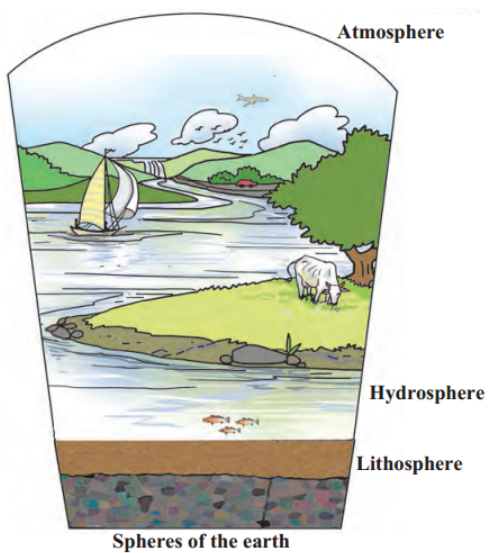

Image

1. Where do you see the birds?

2. Where is the cow grazing?

3. Locate the trees.
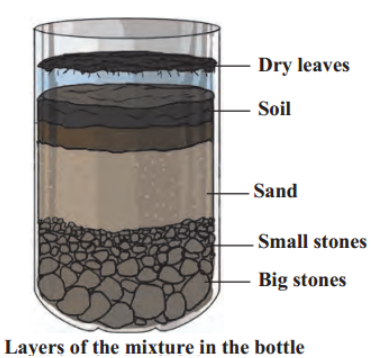
  1. Take a transparent plastic bottle, a handful of soil, big stones, small stones, sand, some dry leaves and water.
  2. Cut off the upper tapering part of the bottle. Put the rest of the materials in the lower part and add water.
  3. Stir the mixture thoroughly and put it aside.

Image

1. Obtain specimens of soil from various places and note the differences in the specimen with respect to colour, feel, texture and size of the particles.

2. Observe how much water is used and for what purposes it is used in your house for a whole day. Record it in a chart. Discuss this data and find out how much water each person needs in your house.

3. How does the mixture in the bottle look now?

Make a list of objects, each of which can be made from several substances.
Classify as directed
Into annual, biennial, perennial
Sunflower, carrot, bajra, mango, jowar, oleander, beetroot, coconut
Classify as directed
Into vertebrates and invertebrates
Fish, cat, earthworm, snail, hen, cockroach
Plants: Ginger, mango, eucalyptus, babul (acacia), teak, spinach, aloevera, turmeric, holy basil, karanja, moh, mulberry, grapevine.
Classify the following substances in the table given below.
(iron, wood, brick, paper, terylene, stone, jute, air, silk, utensils, plastic, rayon, water, wool, dacron, lac, nylon, pearl)
[Chapatti, banana, carrot, butter, Nan, egg, bread, cheese, dal, spinach, milk]