Question
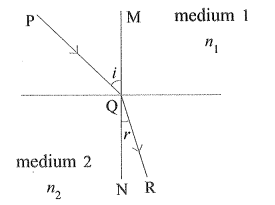
Write Snell's law and derive its general equation.

Answer

Snell's Law : For a given two medium the ratio of the sine of the angle of incidence to the sine of angle of refraction is constant.
$\frac{\sin i}{\sin r}=n_{21}......(1)$
where, $n_{21}$ is the refractive index of the second medium with respect to the first medium.
Image
→absolute refractive index of medium (1),
$n_1=\frac{C}{v_1}$
absolute refractive index of medium (2),
$n_2=\frac{ C }{ v _2}$
(where, C is the velocity of light in vacuum.)
$\begin{array}{l}\therefore n_{21}=\frac{v_1}{v_2} \text { and } \frac{n_2}{n_1}=\frac{v_1}{v_2} \\\therefore n_{21}=\frac{n_2}{n_1}......(2)\end{array}$
→From equation (1) and equation (2),
$\begin{array}{l}\therefore \frac{\sin i}{\sin r}=\frac{n_2}{n_1} \\\therefore n_1 \sin i=n_2 \sin r\end{array}$
→This is called the general equation of Snell's law.

Need a full question paper?

Generate a complete, print-ready paper with questions like this in minutes — across 16+ boards, with answer keys.
Start Generating Free

Similar questions

Sketch graph to show how charge Q given to a capacitor of capacitance C varies with the potential difference.
A parallel beam of light of 500 nm falls on a narrow slit and the resulting diffraction pattern is observed on a screen 1 m away. It is observed that the first minimum is at a distance of 2.5 mm from the centre of the screen. Calculate the width of the slit.
The surface of water in a water tank on the top of a house is 4m above the tap level Find the pressure of water at the tap when the tap is closed Is it necessary to specify that the tap is closed? Take g = 10m/s2.
Write down the expression (equation) to find the distance of $n^{\text {th }}$ bright fringe and $n^{\text {th }}$ dark fringe from the central maximum.
The phenomenon of diffraction is commonly seen in sound waves. But generally not in light waves, why?
An $\alpha$–particle and a proton are moving in the plane of paper in a region where there is a uniform magnetic field directed normal to the plane of the paper. If the particles have equal linear momenta, what would be the ratio of the radii of their trajectories in the field?
Write the centripetal force formula for an electron moving in a stationary orbit in a hydrogen atom and derive the formula for the radius of the orbit.
If we put a cardboard (say 20cm × 20cm) between a light source and our eyes, we can't see the light. But when we put the same cardboard between a sound source and our ear, we hear the sound almost clearly. Explain.
Using lens maker’s formula, derive the thin lens formula $\frac{1}{\text{f}}=\frac{1}{\text{v}}-\frac{1}{\text{u}}$ for a biconvex lens.
The radius of a spherical conductor shell is $R$ and the charge on it is $Q$. Compare the potential at a distance 2 R from the centre of the sphere with the potential at a distance $R / 2$.