Question
Write some properties of electromagnetic waves.

Answer

Some of the properties of electromagnetic waves are :
(i) They are transverse in nature.
(ii) They travel with the speed of light ( $c=3 \times$ $10^8 m / s$ ) in vacuum.
(iii) They do not need any material medium for their propagation.
(iv) They are produced by accelerated or oscillating charge.
(v) These are composed of perpendicular changeable electric and magnetic fields.
(vi) Energy of electromagnetic waves is equally divided between electric and magnetic field vectors.
(vii) They follow the principle of superposition.
(viii) Maximum and minimum magnitudes of $\vec{E}$ and $\overrightarrow{ B }$ are obtained at the same time and same place.

Need a full question paper?

Generate a complete, print-ready paper with questions like this in minutes — across 16+ boards, with answer keys.
Start Generating Free

Similar questions

A piece of wire carrying a current of 6.00A is bent in the form of a circular arc of radius 10.0cm, and it subtends an angle of 120° at the centre. Find the magnetic field B due to this piece of wire at the centre.
The energy flux of sunlight reaching the surface of the earth is $1.388 \times 10^3 W/m^2$. How many photons (nearly) per square metre are incident on the Earth per second? Assume that the photons in the sunlight have an average wavelength of 550 nm.
Distinguish between diamagnetic and ferromagnetic materials in respect of their (i) intensity of magnetisation (ii) behaviour in non-uniform magnetic field and (iii) susceptibility.
What is the de Broglie wavelength of a nitrogen molecule in air at 300 K? Assume that the molecule is moving with the root-meansquare speed of molecules at this temperature. (Atomic mass of nitrogen = 14.0076 u).
A diver having a moment of inertia of $6.0kg-m^2$ about an axis through its centre of mass rotates at an angular speed of 2rad/s about this axis. If he folds his hands and feet to decrease the moment of inertia to $5.0kg-m^2$, what will be the new angular speed?
Prove that the power dissipated in an ideal resistor connected to an ac source is $\frac{\text{V}^2_{\text{eff}}}{\text{R}}.$
Suppose the frequency of the source in the previous example can be varied. (a) What is the frequency of the source at which resonance occurs? (b) Calculate the impedance, the current, and the power dissipated at the resonant condition.

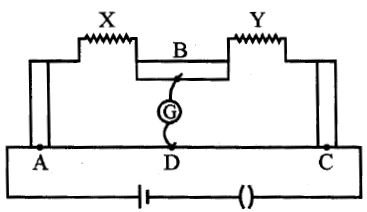
The figure shows experimental set up of a meter bridge. When the two unknown resistances X and Y are inserted, the null point D is obtained 40 cm from the end A. When a resistance of 10 Ω is connected in series with X, the null point shifts by 10 cm. Find the position of the null point when the 10 Ω resistance is instead connected in series with resistance ‘Y’. Determine the values of the resistances X and Y.
How many time constants will elapse before the charge on a capacitors falls to 0.1% of its maximum value in a discharging RC circuit?
What is meant by pure and impure spectrum?