Question
  1. Write the basic nuclear process involved in the emission of$\beta^{+}$ in a symbolic form, by a radioactive nuclear.
  2. in the reactions given below:
  1. $^{11}_{6}\text{C}\rightarrow ^{\text{z}}_{\text{y}}\text{B} + \text{x} + \text{v}$
  2. $^{12}_{6}\text{C}\rightarrow ^{12}_{6}\text{C}\rightarrow^{20}_{\text{a}}\text{Ne} + ^{c}_{b}\text{He}$
Find the values of x,y, and z and a,b and c.

Answer

  1. Basic nuclear reaction.
$\text{P}\rightarrow\text{n} + \text{e}^{+} + \text{v}$
  1.  
  1. $\text{x} = \beta^{+}/^{o}_{1}\text{e} , \text{y} = 5 , \text{z} =11 $
  2. $\text{a} = 10 , \text{b}= 2 , \text{c} = 4.$

Need a full question paper?

Generate a complete, print-ready paper with questions like this in minutes — across 16+ boards, with answer keys.

Start Generating Free

Similar questions

A radio can tune over the frequency range of a portion of $MW$ broadcast band: $(800kHz$ to $1200kHz)$. If its $LC$ circuit has an effective inductance of $200\mu H,$ what must be the range of its variable capacitor? $[$Hint: For tuning, the natural frequency i.e., the frequency of free oscillations of the $LC$ circuit should be equal to the frequency of the radiowave.$]$
A simple pendulum of lerigth $1$ feet suspended from the ceiling of an elevator takes $\frac{\pi}{3}$ seconds to complete one oscillation. Find the acceleration of the elevator.
Find the acceleration of a particle placed on the surface of the earth at the equator due to earth's rotation. The diameter of earth = 12800km and it takes 24 hours for the earth to complete one revolution about its axis.
Can kinetic energy of a system be increased without applying any external force on the system?
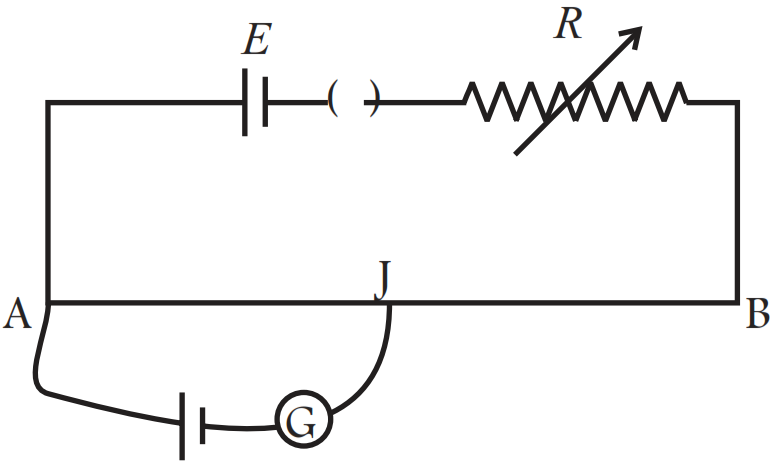
AB is a potentiometer wire (Fig). If the value of R is increased, in which direction will the balance point J shift?
Visible light has wavelengths in the range of 400nm to 780nm. Calculate the range of energy of the photons of visible light.
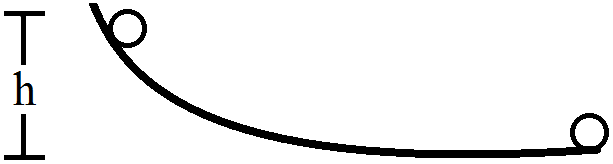
A small spherical ball is released from a point at a height h on a rough track shown in figure. Assuming that it does not slip anywhere, find its linear speed when it rolls on the horizontal part of the track.
A radioactive isotope is being produced at a constant rate $\frac{\text{dN}}{\text{dt}}=\text{R}$ in an experiment. The isotope has a half-life $\text{t}_{\frac{1}2{}}.$ Show that after a time $\text{t}>>\text{t}_{\frac{1}{2}},$ the number of active nuclei will become constant. Find the value of this constant.
$a.$ Using the Bohr's model, calculate the speed of the electron in a hydrogen atom in the $n = 1, 2$ and $3$ levels.
$b$. Calculate the orbital period in each of these levels.
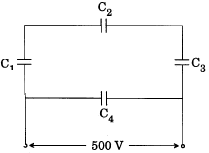
A network of four capacitors each of $12 \mu F$ capacitance is connected to a $500 V$ supply as shown in the figure. Determine $(a)$ equivalent capacitance of the network and $(b)$ charge on each capacitor.