Question
Write the boundary conditions of dimensional equations.

Answer

self

Need a full question paper?

Generate a complete, print-ready paper with questions like this in minutes — across 16+ boards, with answer keys.

Start Generating Free

Similar questions

Figure shows a smooth track which consists of a straight inclined part of length 1 joining smoothly with the circular part. A particle of mass m is projected up the incline from its bottom.
  1. Find the minimum projection-speed v0, for which the particle reaches the top of the track.
  2. Assuming that the projection-speed is 2v0 and that the block does not lose contact with the track before reaching its top, find the force acting on it when it reaches the top.
  3. Assuming that the projection-speed is only slightly greater than v0, where will the block lose contact with the track?
  1. Prove the theorem of perpendicular axes.

(Hint: Square of the distance of a point (x, y) in the x - y plane from an axis through the origin and perpendicular to the plane is x+ y2).

  1. Prove the theorem of parallel axes.

(Hint: If the centre of mass of a system of n particles is chosen to be the origin $\sum\text{m}_{\text{i}}\text{r}_\text{i}=0)$ 

Find the components along the x, y, z axes of the angular momentum l of a particle, whose position vector is r with components x, y, z and momentum is p with components px, py and pz. Show that if the particle moves only in the x-y plane the angular momentum has only a z-component.
A simple pendulum of length I is suspended through the ceiling of an elevator. Find the time period of small oscillations if the elevator,
  1. Is going up with an acceleration a0
  2. Is going down with an acceleration a0.
  3. Is moving with a uniform velocity.
Calculate the frequency of beats produced in air when two sources of sound are activated, one emitting a wavelength of 32cm and the other of 32.2cm. The speed of sound in air is 350m/s.
Two masses m1 and m2 are connected by a spring of spring constant k and are placed on a frictionless horizontal surface. Initially the spring is stretched through a distance x0 when the system is released from rest. Find the distance moved by the two masses before they again come to rest.
Figure. shows two vessels A and B with rigid walls containing ideal gases. The pressure, temperature and the volume are pA, TA, V in the vessel A and pB, TB, V in the vessel B. The vessels are now connected through a small tube. Show that the pressure p and the temperature T satisfy $\frac{\text{p}}{\text{T}}=\frac{1}{2}\Big(\frac{\text{P}_\text{A}}{\text{T}_\text{A}}+\frac{\text{p}_\text{B}}{\text{T}_\text{B}}\Big)$ when equilibrium is achieved.

$\hat{i}$ and $\hat{j}$ are unit vectors along $x$ and $y$ axis respectively. What is the magnitude and direction of the vectors $\hat{i}+\hat{j}$ and $\hat{i}-\hat{j}$ ? What are the component of a vector $\overrightarrow{ A }=2 \hat{ i }+3 \hat{ j }$ along the direction of $\hat{i}+\hat{j}$ and $\hat{i}-\hat{j}$ ? (You can use the graphical method).
A cylinderical piece of cork of density of base area $A$ and height $h$ floats in a liquid of density $\rho_1$. The cork is depressed slightly and then released. Show that the cork oscillates up and down simple harmonically with a period.
$
T=2 \pi \sqrt{\frac{h \rho}{\rho_1 g}}
$
Where $\rho$ is the density of cork. (Ignore damping due to viscosity of the liquid)
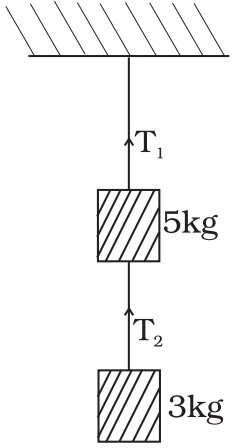
Two masses of 5kg and 3kg are suspended with help of massless inextensible strings as shown in Calculate T1 and T2 when whole system is going upwards with acceleration = 2m s2 (use g = 9.8m s–2).