Question
Write the characteristics of electric field lines.

Answer

►(i) Electric field lines are imaginary curves drawn in such a way that the tangent to it of each point shows the direction of electric field at that point.
  (ii) Field lines start from positive charges and end at negative charges. If there is a single charge, they may start or end at infinity.
  (iii) In a charge-free region, electric field lines can be taken to be continuous curves without any breaks.
  (iv) Two field lines never cross each other.
  (v) Electrostatic field lines do not form any closed loops.
  (vi) Distribution of electric field lines gives an idea of electric field intensity in that region.
  (vii) Field lines of a uniform electric field are mutually parallel and equidistant.

Need a full question paper?

Generate a complete, print-ready paper with questions like this in minutes — across 16+ boards, with answer keys.
Start Generating Free

Similar questions

A gas of hydrogen-like ions is prepared in a particular excited state A. It emits photons having wavelength equal to the wavelength of the first line of the Lyman series together with photons of five other wavelengths. Identify the gas and find the principal quantum number of the state A.
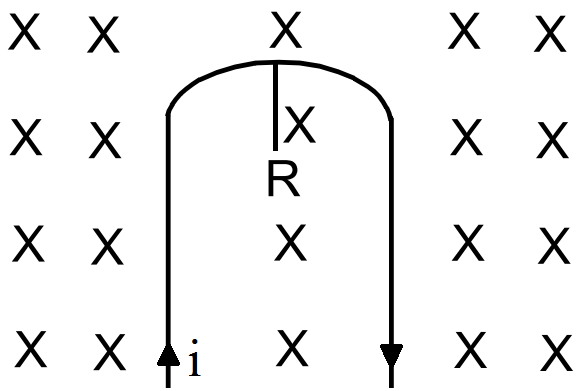
A rigid wire consists of a semi-circular portion of radius R and two straight sections The wire is partially immersed in a perpendicular magnetic field B, as shown in the figure. Find the magnetic force on the wire if it carries a current i.

Write the equation of P.E. of electric dipole in external electric field and discuss its special cases.
The length and the radius of a cylinder measured with a slide callipers are found to be 4.54cm and 1.75cm respectively. Calculate the volume of the cylinder.
Using Ampere’s circuital law, obtain an expression for the magnetic field along the axis of a current carrying solenoid of length l and having N number of turns.
What is electric current ? Explain about it.
State the concept of mobile telephony and explain its working.
Electrons are continuously mobile in any conductor but then too, no electric current flows in the conductor till an electric source is joined across its ends. Explain.
A farsighted person cannot see objects placed closer to 50cm. Find the power of the lens needed to see the objects at 20cm.
Define the term ‘power loss’ in a conductor of resistance R carrying a current I. In what form does this power loss appear? Show that to minimise the power loss in the transmission cables connecting the power stations to homes; it is necessary to have the connecting wires carrying current at enormous high values of voltage.