MCQ
Write the correct answer in the following: In Fig. if $\angle\text{OAB}=40^\circ,$ then $\angle\text{ACB}$ is equal to: 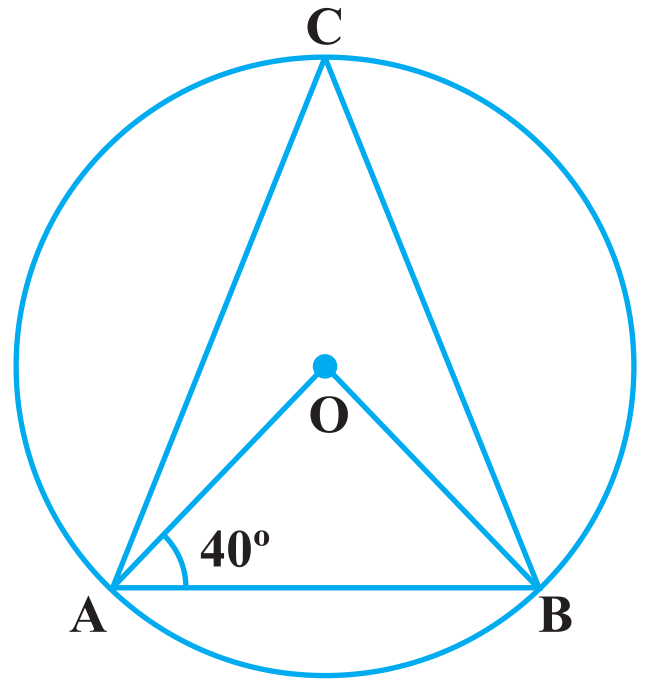
- ✓$50^\circ .$
- B$40^\circ .$
- C$60^\circ .$
- D$70^\circ .$
In $\triangle\text{QAB, OA} = \text{OB}$ [both are the radius of a circle]
$\angle\text{OAB} = \angle\text{OBA}\Rightarrow \angle\text{OBA} = 40^\circ$
[angles opposite to equal sides are equal]
Also, $\angle\text{AOB} = \angle\text{OBA}\Rightarrow \angle\text{BAO} = 180^\circ$
[by angle sum property of a triangle]
$\angle\text{AOB} + 40^\circ + 40^\circ = 180^\circ$
$\Rightarrow\ \angle\text{AOB} = 180^\circ – 80^\circ = 100^\circ$
We know that, in a circle, the angle subtended by an arc at the centre is twice the angle subtended by it at the remaining part of the circle.
$\angle\text{AOB} = 2 \angle\text{ACB} \Rightarrow 100^\circ =2 \angle\text{ACB}$
$\angle\text{ACB} = \frac{100}{2} = 50^\circ$
Generate a complete, print-ready paper with questions like this in minutes — across 16+ boards, with answer keys.