Question
Write the cube in expanded form: ${\left( {2x + 1} \right)^3}$

Answer

${\left( {2x + 1} \right)^3}$
We know that ${\left( {a + b} \right)^3} = {a^3} + {b^3} + 3ab\left( {a + b} \right)$ 
$\therefore {\left( {2x + 1} \right)^3} = {\left( {2x} \right)^3} + {\left( 1 \right)^3} + 3 \times 2x \times 1\left( {2x + 1} \right)$
$ = 8{x^3} + 1 + 6x\left( {2x + 1} \right)\,$
$= 8{x^3} + 12{x^2} + 6x + 1.$
Therefore, the expansion of the expression ${\left( {2x + 1} \right)^3}$ is $8{x^3} + 12{x^2} + 6x + 1$

Need a full question paper?

Generate a complete, print-ready paper with questions like this in minutes — across 16+ boards, with answer keys.

Start Generating Free

Similar questions

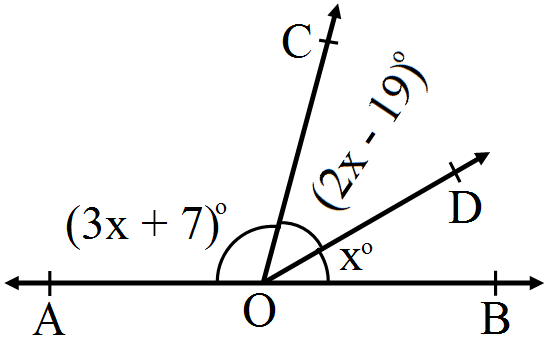
In the adjoining figure, AOB is a straight line. Find the value of x. Also, find $\angle\text{AOC},\angle\text{COD}$ and $\angle\text{BOD}.$

(Street Plan): A city has two main roads which cross each other at the centre of the city. These two roads are along the North-South direction and East-West direction. All the other streets of the city run parallel to these roads and are 200 m apart. There are 5 streets in each direction. Using 1cm = 200 m, draw a model of the city on your notebook. Represent the roads/streets by single lines. There are many cross- streets in your model. A particular cross-street is made by two streets, one running in the North-South direction and another in the East-West direction. Cross street is referred to in this manner: If the 2nd street running in the North-South direction and 5th in the East-West direction meet at some crossing, then we will call this cross-street (2, 5). Using this convention, find: how many cross - streets can be referred to as (3, 4).
In figure, PQRS is a square and T and U are, respectively, the mid-points of PS and QR. Find the area of $\triangle\text{OTS}$ if PQ = 8cm.

In each of the following determine rational numbers a and b:
$\frac{\sqrt{11}-\sqrt7}{\sqrt11+\sqrt7}=\text{a}-\text{b}\sqrt{77}$
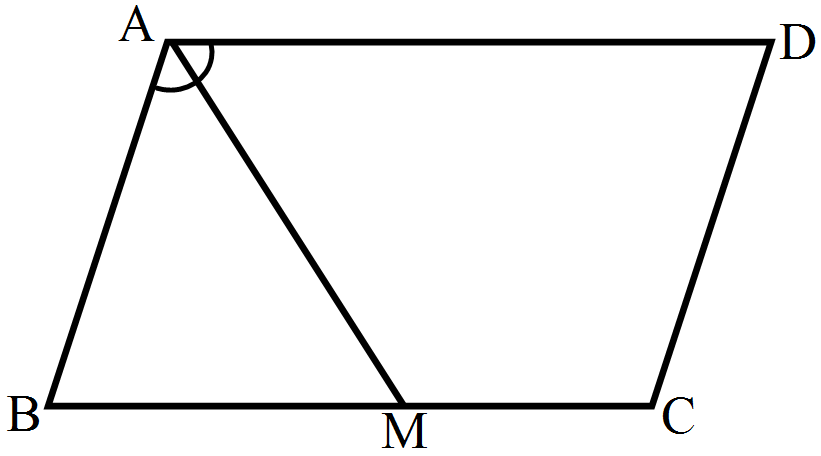
In the adjoining figure, M is the midpoint of side BC of a parallelogram ABCD such that $\angle\text{BAM}=\angle\text{DAM}.$ Prove that AD = 2CD.
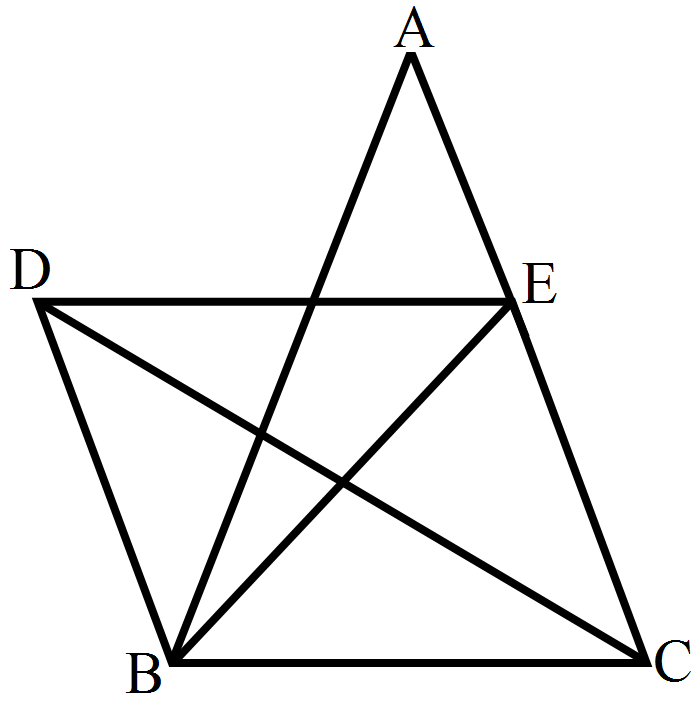
In the adjoining figure, BD || CA, E is the midpoint of CA and $\text{BD}=\frac{1}{2}\text{CA}.$ Prove that $\text{ar}(\triangle\text{ABC})=2\text{ar}(\triangle\text{DBC}).$

AB, CD and EF are three concurrent lines passing throught the point O such that OF bisects $\angle\text{BOD}.$ If $\angle\text{BOF}=35^\circ,$ find $\angle\text{BOC}$ and $\angle\text{AOD}.$
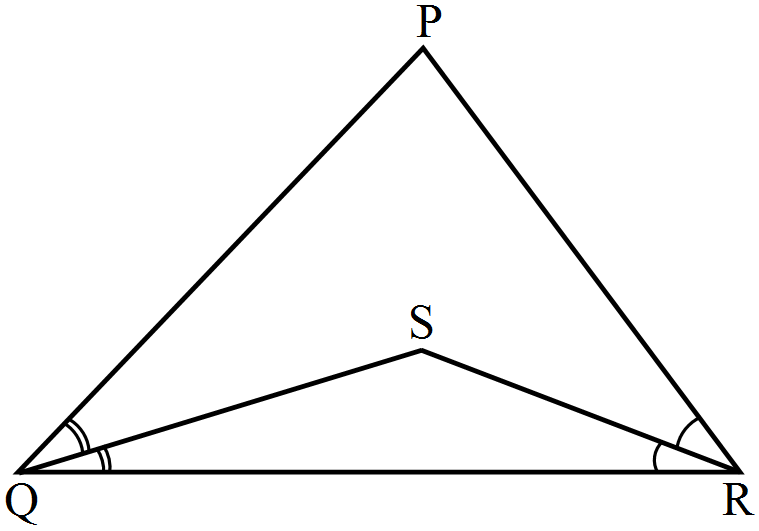
In the given figure, PQ > PR and QS and RS are the bisectors of $\angle\text{Q}$ and $\angle\text{R}$ respectively. Show that SQ > SR.

Angles opposite to equal sides of an isosceles triangle are equal.This result can be proved in many ways. One of the proofs is given here.
If the median of the scores 1, 2, x, 4, 5 (where 1 < 2 < x < 4 < 5) is 3, then find the mean of the scores.