Question
Write the cube in expanded form: ${\left( {2x + 1} \right)^3}$

Answer

${\left( {2x + 1} \right)^3}$
We know that ${\left( {a + b} \right)^3} = {a^3} + {b^3} + 3ab\left( {a + b} \right)$
$\therefore {\left( {2x + 1} \right)^3} = {\left( {2x} \right)^3} + {\left( 1 \right)^3} + 3 \times 2x \times 1\left( {2x + 1} \right)$
$ = 8{x^3} + 1 + 6x\left( {2x + 1} \right)\,$
$= 8{x^3} + 12{x^2} + 6x + 1.$
Therefore, the expansion of the expression ${\left( {2x + 1} \right)^3}$ is $8{x^3} + 12{x^2} + 6x + 1$

Need a full question paper?

Generate a complete, print-ready paper with questions like this in minutes — across 16+ boards, with answer keys.
Start Generating Free

Similar questions

(Street Plan): A city has two main roads which cross each other at the centre of the city. These two roads are along the North-South direction and East-West direction. All the other streets of the city run parallel to these roads and are $200 m$ apart. There are 5 streets in each direction. Using $1\ cm = 200 \ m$, draw a model of the city on your notebook. Represent the roads/streets by single lines. There are many cross- streets in your model. A particular cross-street is made by two streets, one running in the North-South direction and another in the East-West direction. Cross street is referred to in this manner: If the 2nd street running in the North-South direction and $5th$ in the East-West direction meet at some crossing, then we will call this cross-street $(2, 5)$. Using this convention, find: how many cross - streets can be referred to as $(4, 3).$
The mean weight per student in a group of $7$ students is $55\ kg$. The individual weights of $6$ of them (in kg) are $52, 54, 55, 53, 56$ and $54$. Find the weight of the seventh student.
Determine $(8\text{x})^\text{x},$ if $9^{\text{x}+2}=240+9^\text{x}. $
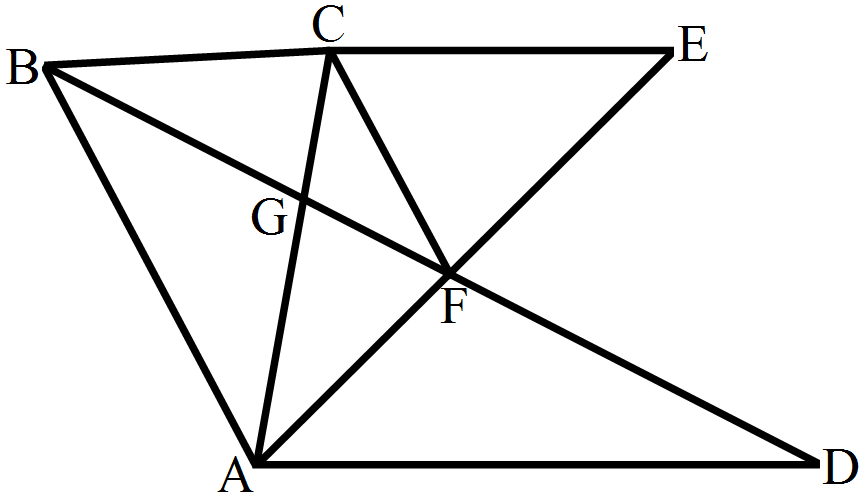
In the adjoining figure, $CE || AD$ and $CF || BA.$ Prove that $\text{ar}(\triangle\text{CBG})=\text{ar}(\triangle\text{AFG}).$
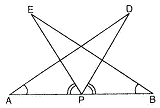
$AB$ is a line segment and $P$ is its mid$-$point. $D $and $E$ are points on the same side of $AB$ such that $\angle BAD = \angle ABE$ and $\angle EPA = \angle DPB.$
Show that:
$i. \triangle DAP \cong \triangle EBP$
$ii. AD = BE$
Factorise: $7(x - 2y)^2 - 25(x - 2y) + 12$
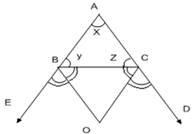
In fig the side $A B$ and $A C$ of $\triangle A B C$ are produced to point $E$ And $D$ respectively. If bisector $B O$ and $C O$ of $\angle C B E$ And $\angle B C D$ respectively meet at point $O$, then prove that $\angle B O C=90^{\circ}-\frac{1}{2} \angle B A C$
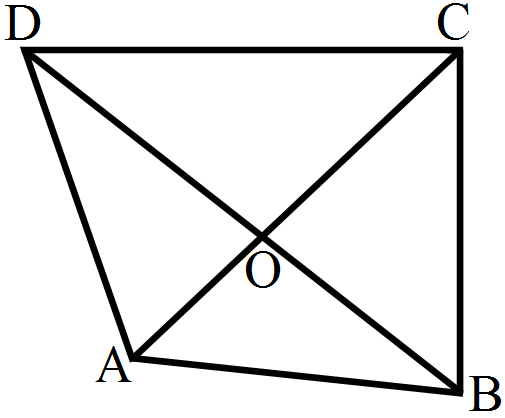
In the adjoining figure, the diagonals $AC$ and $BD$ of a quadrilateral $ABCD$ intersect at $O$. If $BO = OD,$ prove that $\text{ar}(\triangle\text{ABC})=\text{ar}(\triangle\text{ADC}).$
Factorize the following expressions: $a^3 + b^3 + a + b$
Express the following in the form $\frac{\text{p}}{\text{q}},$ where $p$ and $q$ are integers and $\text{q}\neq0$:
$0.\overline{134}$