Question
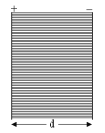
Write the definition of electric capacitance. A parallel plate capacitor is filled with a medium of dielectric constant K between the plates. Find the expression of its capacitance. Draw the necessary diagram.
Answer

When an isolated conductor is charged, its potential increases. The increase in potential is proportional to the charge supplied to the conductor.
$Q \propto V$ or $Q=C V$
Here the proportionality constant C is called the capacitance of the conductor. The value of capacitance C of a conductor depends on its size, shape and the medium used in its construction. Keep in mind that the value of capacitance of a conductor does not depend on the charge on the conductor and the increase in potential across it. If V $=1$ volt in equation (1), then $Q = C$ i.e., the capacitance of the conductor is equivalent to the amount of charge which increases the potential of the conductor by unit amount.
The S.I. unit of capacitance is coulomb/volt, which is called Farad. If in equation (1) $Q =1$ coulomb, $V =1$ volt then $C =1$ Farad.i.e., if on giving 1 coulomb of charge to a conductor, its potential increases by 1 volt, then the capacitance of that conductor is called 1 Farad.
Image
Parallel Plate Capacitor Completely Filled with a Dielectric Here the picture shows a parallel plate capacitor completely filled with dielectric material. The dielectric constant of the material is K and the area of the plates of the capacitor is A and the distance between them is $d$. If in the absence of dielectric material, the charge on the capacitor is $Q _0$ and the potential difference between the plates is $V _0$, then the capacitance of the capacitor in air or vacuum will be $ C_0=\frac{Q_0}{V_0} $
When a material of relative dielectric constant K is filled between the plates of a capacitor, the value of charge on the capacitor does not change due to the presence of the dielectric material filled between the plates. Rather, the value of the potential difference between the plates decrease by $\left(\frac{1}{K}\right)$ times. Therefore potential difference between the plates
$ V=\frac{V_0}{K} $
If the value of capacitance of a capacitor filled with dielectric constant is C then
$C=\frac{Q_0}{V}=\frac{Q_0}{V_0 / K}$
$C =\frac{ Q _0 K}{ V _0}$
$C = C _0 K$
or $C = K \left(\frac{\in_0 A}{d}\right)$
Therefore, the value of capacitance C of a parallel plate capacitor completely filled with dielectric material is K times the value of air or vacuum capacitance $C_0$.

Need a full question paper?

Generate a complete, print-ready paper with questions like this in minutes — across 16+ boards, with answer keys.
Start Generating Free

Similar questions

Each of the resistors shown in figure. has a resistance of $10\Omega$ and each of the batteries has an emf of 10V. Find the currents through the resistors a and b in the two circuits.


What is nature of electromagnetic waves? Explain propagation of wave with the help of a diagram and explain their characteristics in detail.
A capacitor of capacitance $12.0\mu\text{F}$ is connected to a battery of emf 6.00V and internal resistance $1.00\Omega$ through resistanceless leads. $12.0\mu\text{s}$ after the connections are made, what will be (a) the current in the circuit (b) the power delivered by the battery (c) the power dissipated in heat and (d) the rate at which the energy stored in the capacitor is increasing.
Two tiny spheres carrying charges 1.5 µC and 2.5 µC are located 30 cm apart. Find the potential and electric field:
  1. At the mid-point of the line joining the two charges, and
  2. At a point 10 cm from this midpoint in a plane normal to the line and passing through the mid-point.
The resistance of an iron wire and a copper wire at 20°C are $3.9\Omega$ and $4.1\Omega,$ respectively. At what temperature will the resistance be equal? Temperature coefficient of resistivity for iron is $5.0\times10^{-3}\text{K}^{-1}$ and for copper, it is $4.0\times10^{-3}\text{K}^{-1}.$ Neglect any thermal expansion.
Positronium is just like a H-atom with the proton replaced by the positively charged anti-particle of the electron (called the positron which is as massive as the electron). What would be the ground state energy of positronium?
An adiabatic cylindrical tube of cross-sectional area 1cm2 is closed at one end and fitted with a piston at the other end. The tube contains 0.03g of an ideal gas. At 1atm pressure and at the temperature of the surrounding, the length of the gas column is 40cm. The piston is suddenly pulled out to double the length of the column. The pressure of the gas falls to 0.355atm. Find the speed of sound in the gas at atmospheric temperature.
A coil has a resistance of $10\Omega$ and an inductance of 0.4 henry. It is connected to an AC source of $6.5\text{V},\frac{30}{\pi}\ \text{Hz}$ Find the average power consumed in the circuit.
A small town with a demand of 800kW of electric power at 220V is situated 15km away from an electric plant generating power at 440V. The resistance of the two wire line carrying power is 0.5Ω per km. The town gets power from the line through a 4000-220V step-down transformer at a sub-station in the town.
  1. Estimate the line power loss in the form of heat.
  2. How much power must the plant supply, assuming there is negligible power loss due to leakage?
  3. Characterise the step up transformer at the plant.
A parallel plate capacitor is to be designed with a voltage rating 1kV, using a material of dielectric constant 3 and dielectric strength about 107Vm–1. (Dielectric strength is the maximum electric field a material can tolerate without breakdown, i.e., without starting to conduct electricity through partial ionisation.) For safety, we should like the field never to exceed, say 10% of the dielectric strength. What minimum area of the plates is required to have a capacitance of 50pF?