Question
Write the difference between:
Red and White muscles

Answer

Differences between Red and White Muscles
S. No.Red MuscleWhite Muscle
1.Red muscles appear red due to a higher presence of myoglobin, hence termed as red muscles.White muscles appear white due to a lower presence of myoglobin, hence termed as white muscles.
2.Red muscles have more mitochondria.White muscles have fewer mitochondria.
3.They have a lower content of glycogen.They have a higher content of glycogen.
4.Red muscles are also known as oxidative muscles.White muscles are known as glycolytic muscles.
5.Energy in red muscles is obtained through aerobic respiration.Energy in white muscles is obtained through anaerobic respiration.
6.They have more blood capillaries.They have fewer blood capillaries.
7.These muscles have smaller diameter fibres.These muscles have larger diameter fibers.
8.They do not produce lactic acid.They produce lactic acid.
9.Red muscles do not easily experience fatigue.White muscles easily experience fatigue.
10.They contract slowly.They contract rapidly.
11.The fibres are thinner as compared to white filaments.White fibres are thicker than red filaments.
12.Example: Muscle fibres of human back.Example: Muscles of the eyeball.

Need a full question paper?

Generate a complete, print-ready paper with questions like this in minutes — across 16+ boards, with answer keys.
Start Generating Free

Similar questions

  1. Name the first stable compound formed in sugarcane plant during CO2, fixation.
  2. Describe Hatch and Slack pathway of CO2, fixation.
Explain sliding filament theory of muscle contraction with neat sketches.
Explain the differences between bone and cartilage.
Explain meiosis-II in an animal cell.
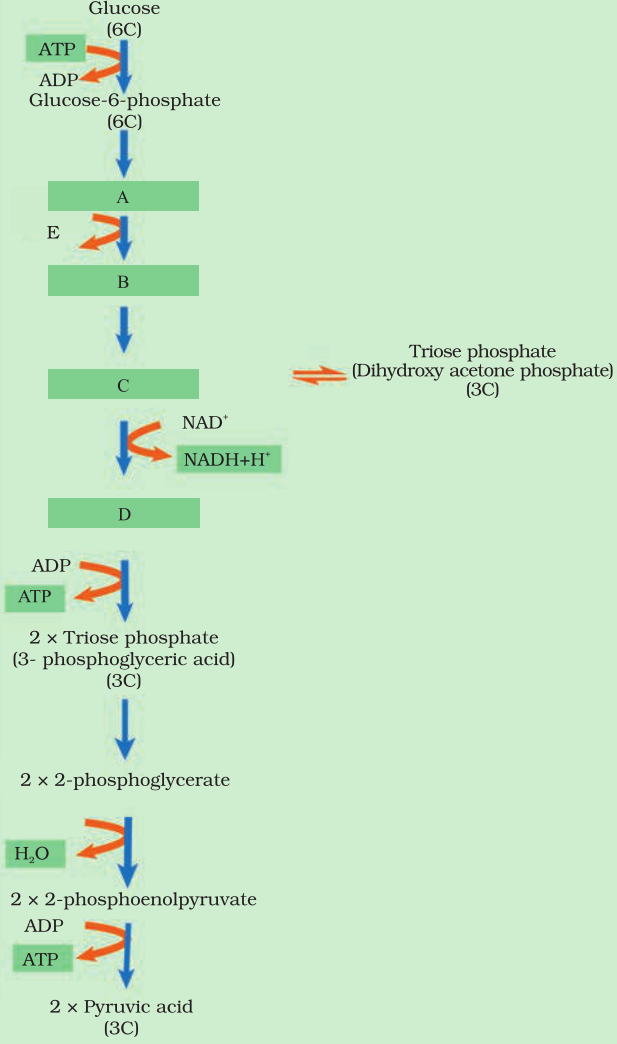
The figure given below shows the steps in glycolysis. Fill in the missing steps A, B, C, D and also indicate whether ATP is being used up or released at step E?

Write differences between flagella and cilia.
Justify the statement, “Mitochondria are power houses of the cell”.
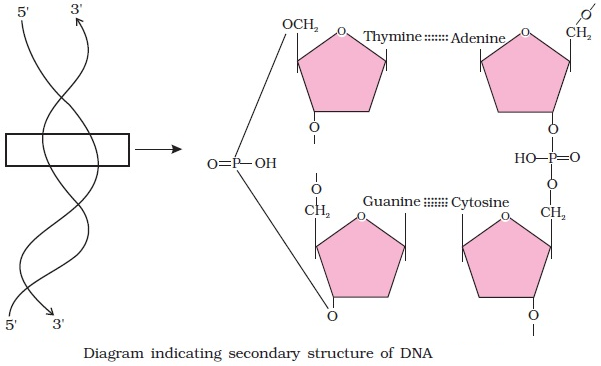
  1. Identify the structure shown in figure.
  2. Write the measurement (distance) of the parts marked (A), (B), (C).
  3. How many H-bonds are there at the place marked as (6)?
  4. Which form of DNA is shown in the figure?
  5. Whether B type DNA has left-handed spiral structure or right- handed?

Amit went on mountain for trekking. After reaching at about 2000 m height. He experienced difficulty in breathing. His rate of breathing increased and he decided to discontinue the trek and return back to the ground. Being concerned about his health. ls consulted his doctor friend about it? His friend explained that it is a normal phenomenon and he should have carried an oxygen cylinder while going for the trek.
  1. Why is it difficult to breathe as we go up on a height?
  2. Why does his friend suggested to carry an oxygen cylinder?
  3. Which component of blood show its increase when someone moves from plains to higher altitudes?
  4. What values are shown by Amit?
Describe the sequence of events which occur in the cardiac cycle. Where and how are the sounds of ‘lub' and 'dub’ produced in the heart during this cycle?