Question
Write the differences between mass and weight of an object.

Answer

Mass
Weight
1.
The mass of an object is the quantity of matter contained in it.
The weight of an object is the force with which it is attracted towards the centre of the earth.
2.
SI unit of mass is kilogram (kg).
SI unit of mass is newton (N).
3.
The mass of an object is constant.
The weight of an object is not constant. It changes with the change in acceleration due to gravity.
4.
The mass of an object can never be zero.
The weight of an object can be zero.

Need a full question paper?

Generate a complete, print-ready paper with questions like this in minutes — across 16+ boards, with answer keys.

Start Generating Free

Similar questions

Draw a neat and labelled diagram of the human ear. With the help of this diagram, explain the construction and working of the human ear.
Differentiate between a saturated and an unsaturated solution. How will you test whether a given solution is saturated or not?
Give the chemical formulae for the following compounds and compute the ratio by mass of the combining elements in each one of them.
  1. Ammonia
  2. Carbon monoxide
  3. Hydrogen chloride
  4. Aluminium fluoride
  5. Magnesium sulphide

Ravi suffered from tuberculosis, while Rehman suffered from typhoid. Which disease caused more damage and why?
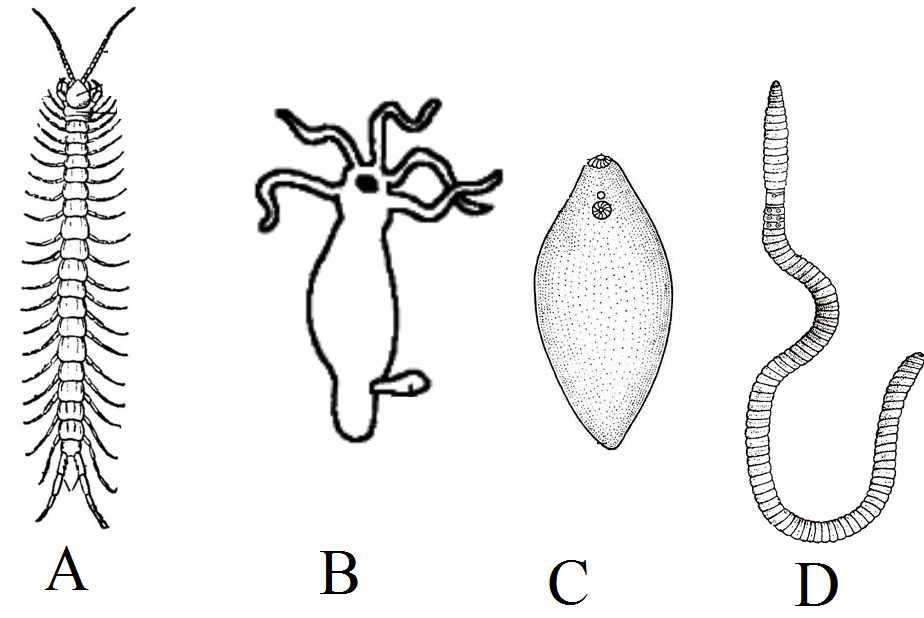
How would you prepare a saturated solution of sodium chloride in water at 25°C? What will happen if this solution is cooled to 10°C?

  1. Identify figure A to D.
  2. Which one of them is (i) diplobalstic; (ii) Coelomate?
  3. Which triplobalstic animal is (i) Acoelomate; (ii) Coelomate?
  4. Which one belong to phylum (i) Cnidaria; (ii) Platyhelminthes; (iii) Annelids; (iv) Arthropoda?
  5. Which one of them has (i) Organ level organization? (ii) Organ system level organization?
  6. Which one of them has excretory organs in the form of (i) Flame cells; (ii) Nephridia?
  7. Which one of them has trachea as the respiratory organ? 
Write the cations and anions present, if any, in the following:
  1. CH3COONa
  2. NaCl
  3. H2
  4. NH4NO3
Describe an experiment to show that sound cannot pass through vacuum.
Mention differences between light microscope and electron microscope.
A boy walks from his classroom to the bookshop along a straight corridor towards North. He covers a distance of 20m in 25 seconds to reach the bookshop. After buying a book, he travels the same distance in the same time to reach back in the classroom. Find (a) average speed, and (b) average velocity, of the boy.