Question
Write the formula for refraction by a lens.

Answer

$\frac{1}{f}=\left(n_{21}-1\right)\left(\frac{1}{ R _1}-\frac{1}{ R _2}\right)$ $\because n_{21}=\frac{n_2}{n_1}$

Need a full question paper?

Generate a complete, print-ready paper with questions like this in minutes — across 16+ boards, with answer keys.
Start Generating Free

Similar questions

There are 1000 turns in 1 meter length of the core of a solenoid and a current of 2A is flowing through it. What is the magnitude of magnetizing field H?
The brightness producing capacity of a source:
  1.  Does not depend on its power.
  2.  Does not depend on the wavelength emitted.
  3.  Depends on its power.
  4.  Depends on the wavelength emitted.
Write the importance of Huygens principle. What are the two assumptions of this theory?
The lower end of a capillary tube of radius 1mm is dipped vertically into mercury:
  1. Find the depression of mercury column in the capillary.
  2. If the length dipped inside is half the answer of part (a), find the angle made by the mercury surface at the end of the capillary with the vertical. Surface tension of mercury = 0.465N/m and the contact angle of mercury with glass = 135°.
An air bubble is formed inside water. Does it act as a converging lens or a diverging lens?
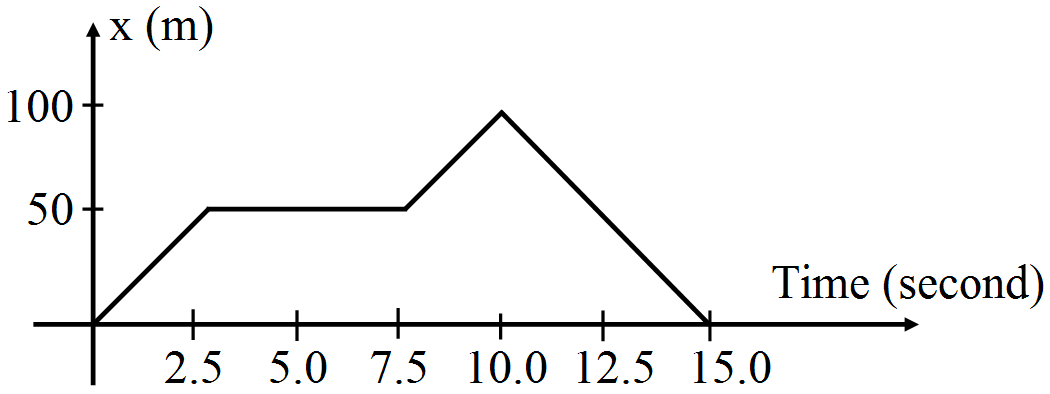
Figure shows the graph of the x-coordinate of a particle going along the X-axis as a function of time. Find:
  1. The average velocity during 0 to 10s.
  2. Instantaneous velocity at 2, 5, 8 and 12s.

Define electric dipole moment. Write its S.I. unit.
In a transistor, both emitter and collector regions are of the same nature of doping. Can these regions be interchanged?
How does the mutual inductance of a pair of coils change when
  1. Distance between the coils is increased and
  2. Number of turns in the coils is increased?
Which property of light is confirmed by the pattern of polarization?