Question
Write the formula for refraction on a spherical surface.

Answer

$\frac{n_2}{v}-\frac{n_1}{u}=\frac{n_2-n_1}{ R }$

Need a full question paper?

Generate a complete, print-ready paper with questions like this in minutes — across 16+ boards, with answer keys.
Start Generating Free

Similar questions

Write any two drawbacks of Rutherford's experiment related to atomic structure.
  1. Calculate the energy released if 238U emits an $\alpha$-particle.
  2. Calculate the energy to be supplied to 238U it two protons and two neutrons are to be emitted one by one. The atomic masses of 238U, 234Th and 4He are 238.0508u, 234.04363u and 4.00260u respectively.
Is the formula "Real depth/ Apparent depth $=\mu$" valid if viewed from a position quite away from the normal?
If the magnetic field outside a copper box is suddenly changed, what happens to the magnetic field inside the box? Such low-resistivity metals are used to form enclosures which shield objects inside them against varying magnetic fields.
The speeds of red light and yellow light are exactly same:
  1. In vacuum but not in air.
  2. In air but not in vacuum.
  3. In vacuum as well as in air.
  4. Neither in vacuum nor in air.
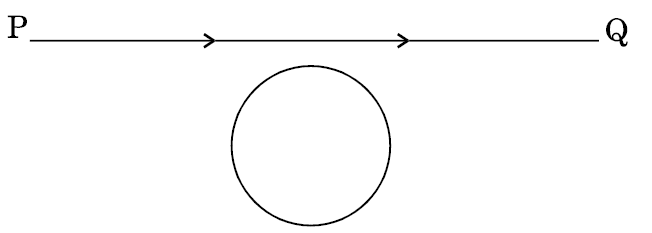
A conducting loop is held below a current carrying wire PQ as shown. Predict the direction of the induced current in the loop when the current in the wire is constantly increasing.

A magnet of magnetic moment m is first cut perpendicular to its length and then perpendicular to its breadth into n equal parts, then calculate magnetic moment of each part.
Will a current loop placed in a magnetic field always experience a zero force?
Magnetic scalar potential is defined as

$\text{U}(\overrightarrow{\text{r}_2})-\text{U}(\overrightarrow{\text{r}_1})=-\int\limits^{\vec{\text{r}}_2}_{\vec{\text{r}_1}} \vec{\text{B}}.\text{d}\vec{\text{l}}.$

Apply this equation to a closed curve enclosing a long atraicht wire. The RHS of the above equation is then $-{\mu}_\text{o} \text{ i}$ by Ampere's law. We see that $\text{U}(\vec{\text{r}_2})\neq\text{U}(\vec{\text{r}_1})$ even when $\vec{\text{r}_2}=\vec{\text{r}_1}.$Can we have a magnetic acalar potential in this case?

A circular loop of radius 4.0cm is placed in a horizontal plane and carries an electric current of 5.0A in the clockwise direction as seen from above. Find the magnetic field:
  1. At a point 3.0cm above the centre of the loop.
  2. At a point 3.0cm below the centre of the loop.