Question
Write the Lewis dot structure of the CO molecule.

Answer

Step 1. Count the total number of valence electrons of carbon and oxygen atoms. The outer (valence) shell configurations of carbon and oxygen atoms are:
$2 s^2 2 p^2$ and $2 s^2 2 p^4$, respectively. The valence electrons available are $4+6=10$.
Step 2. The skeletal structure of CO is written as: CO
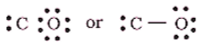
Step 3. Draw a single bond (one shared electron pair) between $C$ and $O$ and complete the octet on $O$, the remaining two electrons are the lone pair on C .
Image
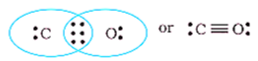
This does not complete the octet on carbon and hence we have to resort to multiple bonding (in this case a triple bond) between C and O atoms. This satisfies the octet rule condition for both atoms. 
Image

Need a full question paper?

Generate a complete, print-ready paper with questions like this in minutes — across 16+ boards, with answer keys.
Start Generating Free

Similar questions

Why is nitric acid added to sodium extract before adding silver nitrate for testing halogens?
How many grams of KClO3 must be decomposed to prepare 3.36 litres of oxygen at STP? (Atomic weight of K = 39, Cl= 35.5, 0 = 16u)
Describe the theory associated with the radius of an atom as it:
1. gains an electron
2. loses an electron
Emission transitions in the Paschen series end at orbit $n =3$ and start from orbit n and can be represeted as $v =$ $3.29 \times 10^{15}(Hz)\left[1 / 3^2-1 / n ^2\right]$ Calculate the value of n if the transition is observed at 1285 nm . Find the region of the spectrum.
If 0.561 g of KOH is dissolved in water to give 200 mL of solution at 298 K . Calculate the concentration of potassium, hydrogen and hydroxyl ions. What is its pH ?
Find:

  1. The total number and.
  2. The total mass of neutrons in 7 mg of 14C.

(Assume that mass of a neutron = 1.675 × 10⁻²⁷kg).

An alkyl halide (X) of formula C3H13Cl on treatment with alcoholic KOH or potassium tert-butoxide gives two isomeric alkenes Yand Z(C6H12). Both alkenes on hydrogenation give 2, 3-dimethylbutane. Predict the structure of X, Y and Z.
1. Give the mathematical expression of enthalpy.
2. Neither q nor W is a state function but $q + W$ is a state function. Explain why?
3. The standard heat of formation of $Fe _2 O _3$ (s) is $824.2 kJ mol ^{-1}$ Calculate heat change for the reaction.
$
4 Fe(s)+3 O_2(g) \rightarrow 2 Fe_2 O_3(s)
$
  1. Define principal quantum number(n).
  2. Write the electronic configuration of Cr+ [Atomic number of Cr = 24].
  3. Define Pauli's exclusion principle.
Following data is given for the reaction: $\text{CaCO}_3\text{(s)}\xrightarrow{ \ \ \ \ \ \ \ \ \ \ \ }\text{CaO(s)}+\text{CO}_2\text{(g)}$
$\Delta_\text{f}\text{H}^\ominus[\text{CaO}\text{(s)}]=-635.1\text{KJ mol}^{-1}$
$\Delta_\text{f}\text{H}^\ominus[\text{CO}_2\text{(g)}]=-393.5\text{KJ mol}^{-1}$
$\Delta_\text{f}\text{H}^\ominus[\text{CaCO}_3\text{(s)}]=-1206.9\text{KJ mol}^{-1}$
Predict the effect of temperature on the equilibrium constant of the above reaction.