Question
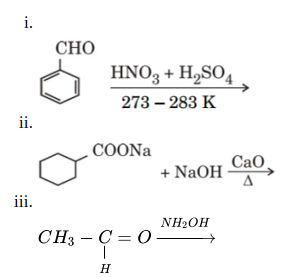
Write the major products in the following:
Image

Answer

Get the step-by-step solution for this question inside the Vidyadip app.

Get the answer in the app

Need a full question paper?

Generate a complete, print-ready paper with questions like this in minutes — across 16+ boards, with answer keys.

Start Generating Free

Similar questions

Silver is deposited on a metallic vessel by passing a current of 0.2 amps. for 3 hrs. Calculate the weight of silver deposited. (At mass of silver = 108 amu, 1 F = 96500 C)?
Calculate the e.m.f at $25^{\circ} c$ for the following cell:
$N i(s)\left|N i^{2+}(0.01 M) \| C u^{2+}(0.1 M)\right| C u(s)$
Given: $E ^0 Ni ^{+2} / Ni =-0.25 V$
$E_{C u^{2+} / C u}^0=+0.34 V$
$\left[1 F=96,500 Cmol ^{-1}\right]$. Calculate the maximum work that can be accomplished by the operation of this cell
(a) How will you prepare phenol from benzenediazonium chloride?
(b) How will you convert salicylic acid into phenol?
The Fischer projection of D-Glucose is given alongside. What happens when L-Glucose is treated with Tollens’ reagent?
Write the equation of the reaction of hydrogen iodide with:
i. 1-propoxypropane
ii. Methoxybenzene
iii. Benzyl ethyl ether
Give four examples of heterogeneous catalysis.
Account for the following:
  1. Bi(V) is a stronger oxidizing agent than Sb(V).
  2. N-N single bond is weaker than P-P single bond.
  3. Noble gases have very low boiling points.
The following results have been obtained during the kinetic studies of the reaction.
$2A + BC → D$
Experiment $[A]/mol \ L-1$ $[B]/mol \ L-1$ Initial rate of formation of $D/mol \ L-1 \ min-1$
$I$ $0.1$ $0.1$ $6.0 \times 10^{-3}$
$II$ $0.3$ $0.2$ $7.2 \times 10^{-2}$
$III$ $0.3$ $0.4$ $2.88 \times 10^{-1}$
$IV$ $0.4$ $0.1$ $2.40 \times 10^{-2}$
Determine the rate law and the rate constant for the reaction.
How is $SO_2$ an air pollutant?
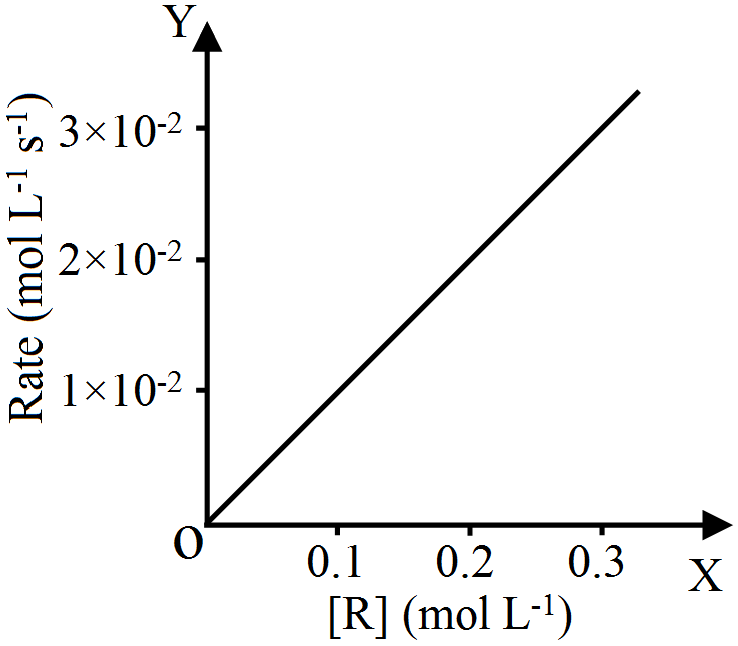
The rate for the reaction $R→P$ is rate = k[R]. It has been shown graphically below. What is rate constant for the reaction?