Question
  1. Write the palindromic nucleotide sequence for the following DNA segment:

5' - GAATTC - 3'

  1. Name the restriction endonuclease that recognises this sequence.
  2. How are 'sticky ends' produced? Mention their role.

Answer

  1. 5' - GAATTC - 3'
3' - CTTAAG - 5'
  1. EcoRI is the restriction endonuclease that recognizes this palindrome.
  2. When the restriction enzyme cuts the DNA strands a little away from the centre of the palindromic sequence, between the same two bases on both the strands, sticky ends are produced.
  • The stickiness of the ends facilitates the action of the enzyme DNA-ligase.

Need a full question paper?

Generate a complete, print-ready paper with questions like this in minutes — across 16+ boards, with answer keys.

Start Generating Free

Similar questions

When Morgan conducted a dihybrid cross on Drosophila like Mendel did with pea plants, the F, ratios deviated significantly from that of Mendels F, ratio. Write the explanation Morgan and his group gave for the observations they obtained from their experiments.

Or

Morgan carried out several dihybrid crosses in Drosophila and found F, ratios deviated very significantly from the expected Mendelian ratio. Explain his findings with the help of an example.
What is meant by emasculation? When and why does a plant breeder employ this technique?
Explain the process of artificial hybridisation to get improved crop variety in:
  1. Plants bearing bisexual flowers.
  2. Female parent producing unisexual flowers.
Explain the internal structure of testis (Figure is not essential).
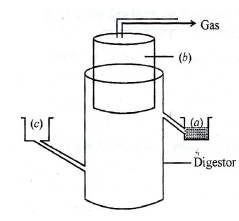
The diagram above is that of a typical biogas plant.Explain the sequence of events occurring in a biogas plant. Identify a, b and c.
Write a Note about: STIs
Explain convergent and divergent evolution with the help of one example of each.
Name the type of interaction seen in each of the following examples:
  1. Ascaris worms living in the intestine of human.
  2. Wasp pollinating fig inflorescence.
  3. Clown fish living among the tentacles of sea-anemone.
  4. Mycorrhizae living on the roots of higher plants.
  5. Orchid growing on a branch of a mango tree.
  6. Disappearance of smaller barnacles when Balanus dominated in the Coast of Scotland.
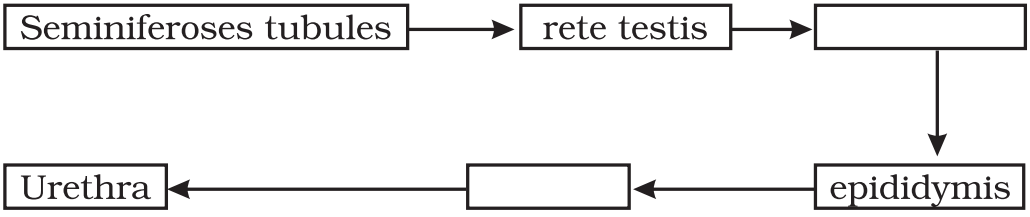
The path of sperm transport is given below. Provide the missing steps in blank boxes.

According to the 10% law given by Lindeman, only 10% of the energy is transferred to the next trophic level.
  1. Name the process by which an organism produces energy.
  2. What is the most common substrate used in this pathway?
  3. Which biomolecule is also known as energy currency of the cell?