Question
Write the product of equivalent capacitances when 10 capacitors, each having a capacitance of $10 \mu F$, are connected in series and then parallel connection.

Answer

Equivalent capacitance of series combination of $n$ capacitors will be
$ \frac{1}{C_{s}}=\frac{1}{C_1}+\frac{1}{C_2}+\frac{1}{C_3}+\ldots \ldots+\frac{1}{C_n} $
There are 10 capacitors each with a capacitance of $10 \mu F$.All of these are combined into series combinations. Therefore the value of equivalence will be $1 \mu F$.
All these have been combined in parallel combination after series combination.
Formula of equivalency for parallel combination :
$C _{ P }= C _1+ C _2+ C _3 \ldots \ldots C _n$
$\begin{array}{r}\therefore C _{ P }=10+10+10+10+10+10+10+10+ \\ 10+10=100 \mu F\end{array}$
The product of both the capacitances
$= C _{ S } \times C _{ P }=1 \mu F \times 100 \mu F$
$=1 \times 10^{-6} F \times 100 \times 10^{-6} F$
$=10^{-10} F=1 A F$ Ans.

Need a full question paper?

Generate a complete, print-ready paper with questions like this in minutes — across 16+ boards, with answer keys.

Start Generating Free

Similar questions

(a) What happens if a bar magnet is cut into two pieces: (i) transverse to its length, (ii) along its length?
(b) A magnetised needle in a uniform magnetic field experiences a torque but no net force. An iron nail near a bar magnet, however, experiences a force of attraction in addition to a torque. Why?
(c) Must every magnetic configuration have a north pole and a south pole? What about the field due to a toroid?
(d) Two identical looking iron bars A and B are given, one of which is definitely known to be magnetised. (We do not know which one.) How would one ascertain whether or not both are magnetised? If only one is magnetised, how does one ascertain which one? [Use nothing else but the bars A and B.]
In one-dimensional elastic collision of equal masses, the velocities are interchanged. Can velocities in a onedimensional collision be interchanged if the masses are not equal?
Potential at an instant $t$ in an ac circuit is $E=200 \sin 157 t . \cos 157 t$ volts and current is $I=\sin \left(314 t+\frac{\pi}{3}\right) \quad$ Amperes. In this condition calculate :
(a) frequency
(b) root mean square value of voltage
(c) impedance of the circuit
(d) power factor.
A water particle of mass $10.0\ mg$ and having a charge of $1.50 \times 10^{-6}C$ stays suspended in a room. What is the magnitude of electric field in the room? What is its direction?
Draw the circuit diagram showing how a p-n junction diode is
i. forward biased
ii. reverse biased
How is the width of depletion layer affected in the two cases?
Draw a schematic diagram of the experimental arrangement used by Davisson and Germer to establish the wave nature of electrons. Explain briefly how the de$-$Broglie relation was experimentally verified in case of electrons.
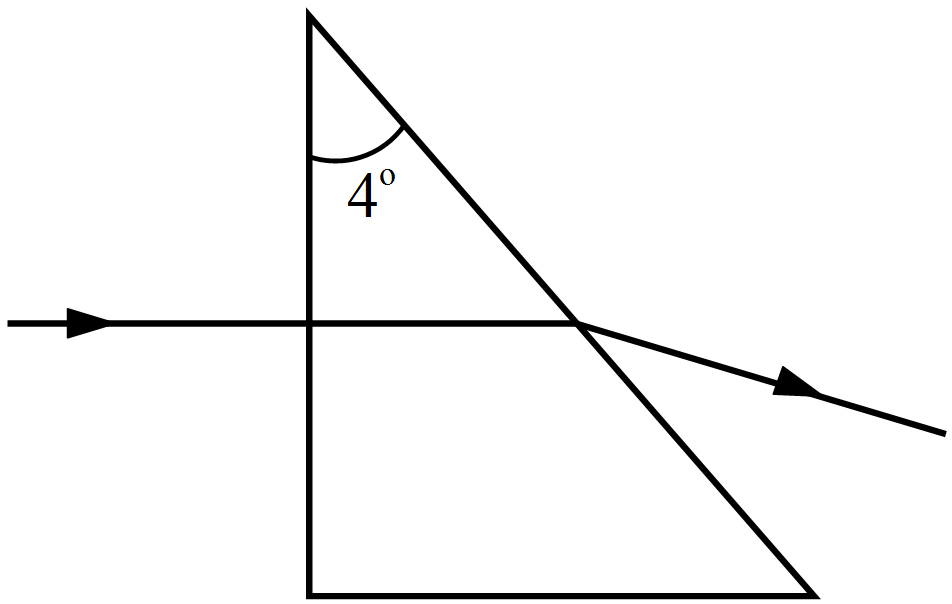
Find the angle of deviation suffered by the light ray shown in figure. The refractive index $\mu=1.5$ for the prism material.
A capacitor of capacitance $100\mu\text{F}$ is connected to a battery of 20 volts for a long time and then disconnected from it. It is now connected across a long solenoid having 4000 turns per metre. It is found that the potential difference across the capacitor drops to 90% of its maximum value in 2.0 seconds. Estimate the average magnetic field produced at the centre of the solenofd during this period.
A radio can tune over the frequency range of a portion of $MW$ broadcast band: $(800kHz$ to $1200kHz)$. If its $LC$ circuit has an effective inductance of $200\mu H,$ what must be the range of its variable capacitor? $[$Hint: For tuning, the natural frequency i.e., the frequency of free oscillations of the $LC$ circuit should be equal to the frequency of the radiowave.$]$
Draw the graph of binding energy per nucleon against atomic mass number and draw conclusion of the graph.